

Your production line runs smoothly until a customer rejects your parts for being “out of specification.” You check your measurements twice, but the same instruments that passed your internal quality checks now show different results than your customer’s equipment. What went wrong? Your measurement instruments lost their connection to national standards, breaking the traceability chain that validates every dimension you produce. This situation highlights why precision gage block calibration services are essential for maintaining measurement confidence.
Gage block calibration creates the foundation for measurement traceability by linking your instruments to NIST standards through documented calibration chains. This connection validates every measurement your facility makes and protects product quality across industries. Without this link, your quality control data becomes unreliable, leading to customer disputes and potential recalls.
Traceability means your measurements connect to recognized national standards through an unbroken chain of calibrations. When this chain breaks, your measurements lose credibility with customers and regulatory bodies. F.D. Hurka Metrology has provided this critical link since 1972, helping manufacturers maintain measurement confidence through rigorous gage block calibration services in North Carolina.
What Is Gage Block Calibration
Gage blocks are precision steel or ceramic rectangles with exact thickness dimensions that serve as physical measurement standards. These blocks stack together to create precise lengths for calibrating measuring instruments. Your micrometers, calipers, and height gages depend on accurately calibrated gage blocks for proper function.
The calibration process compares your gage blocks to reference standards with known accuracy. Our technicians measure each block’s actual dimensions and document any deviations from nominal values. This creates a calibration certificate showing the true dimensions and measurement uncertainty.
F.D. Hurka Metrology performs these calibrations using equipment traceable to NIST standards. Each calibration follows documented procedures that maintain the measurement chain from your shop floor back to national references.
Understanding Measurement Traceability
Measurement traceability establishes an unbroken chain of calibrations connecting your instruments to national measurement standards. This chain validates that your measurements are accurate and reliable for quality control decisions.
NIST defines traceability as “the property of a measurement result whereby the result can be related to a reference through a documented unbroken chain of calibrations.” Each link in this chain must have documented measurement uncertainty.
The Traceability Chain Structure
The measurement chain starts with NIST primary standards at the national level. Secondary standards calibrate against these primary references. Working standards are then calibrated against secondary standards. Your shop instruments calibrate against these working standards.
F.D. Hurka Metrology maintains working standards that trace directly to NIST through accredited calibration laboratories. Our precision gage block calibration services create the documented link your quality system requires.
Why Traceability Matters for Quality Control
Traceability provides confidence that your measurements accurately represent product dimensions. Without traceable calibrations, your quality control data lacks credibility with customers and auditors.
ISO 9001 requires measurement equipment traceability to international or national standards. Customer contracts often specify traceability requirements for supplied products. Regulatory compliance frequently mandates traceable measurements for safety-critical applications.
Customer Confidence Benefits
Traceable measurements demonstrate your commitment to quality and accuracy. Customers trust data backed by documented calibration chains. This trust translates to stronger business relationships and repeat orders.
F.D. Hurka Metrology helps you build customer confidence through our metrology traceability services in Charlotte. We provide the documentation and accuracy your customers expect from quality suppliers.
NIST Traceable Calibration Requirements
NIST traceable calibration services must follow specific requirements for documentation, uncertainty analysis, and measurement procedures to maintain calibration validity and measurement chain integrity. According to NIST’s official policy, providers must document the measurement process and describe the complete calibration chain connecting to specified references.
Documentation Standards
Every calibration certificate must identify the measurement method used, reference standards employed, environmental conditions during calibration, and complete uncertainty analysis. Each step requires documented measurement uncertainty that accounts for all error sources. Calibration providers must demonstrate competence through ISO/IEC 17025 accreditation with qualified personnel and appropriate capabilities.
Our NIST traceable calibration services in NC meet these stringent requirements through A2LA accreditation and documented procedures.
F.D. Hurka Metrology’s Calibration Capabilities
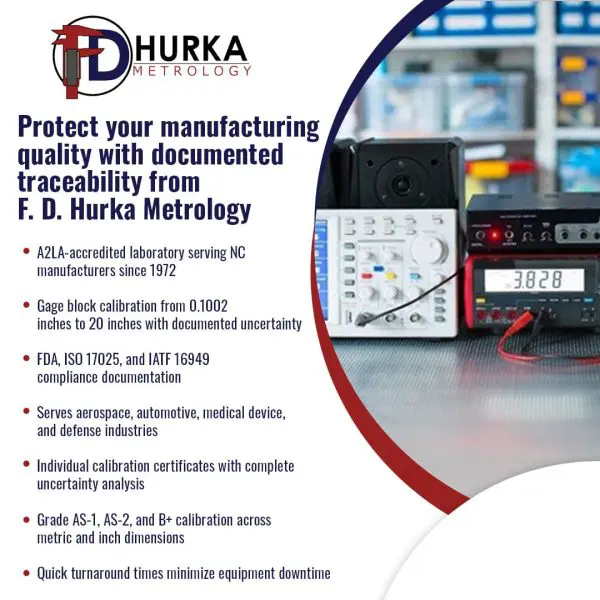
F.D. Hurka Metrology provides comprehensive gage block calibration using NIST traceable standards and documented procedures. Our capabilities include grade AS-1, AS-2, and B+ gage block sets across metric and inch dimensions.
We calibrate gage blocks from 0.1002 inches to 20 inches in length. Metric capabilities extend from 0.5 mm to 500 mm. Our measurement uncertainty ranges from ±0.000008 inches to ±0.000040 inches, depending on block size and grade.
Calibration Process Overview
Our calibration process begins with incoming inspection and cleaning. We use electronic comparators for dimensional measurement against certified reference standards. Temperature stabilization assures measurement accuracy during calibration.
Each gage block receives individual measurement and documentation. We create calibration certificates showing actual dimensions, deviations from nominal, and measurement uncertainty. This documentation supports your traceability requirements completely.
Industries Requiring Traceable Measurements
Aerospace, automotive, medical device, and defense industries mandate traceable measurements for product acceptance. These industries face strict quality requirements where measurement accuracy directly impacts safety and performance.
The Federal Aviation Administration requires traceable calibrations for aircraft component manufacturing. Automotive suppliers must meet IATF 16949 requirements, including measurement traceability. Medical device manufacturers face FDA regulations demanding calibration documentation.
Aerospace Applications
Aerospace components demand extreme dimensional accuracy for flight safety. Engine parts, structural components, and control systems require precise measurements during manufacturing. Our gage block calibration services in North Carolina support these critical applications.
Turbine blade manufacturing uses gage blocks for setting up coordinate measuring machines. Wing assembly processes depend on accurate measurement standards for proper fit and function. F.D. Hurka Metrology provides the measurement foundation these processes require.
Automotive Manufacturing
Modern vehicles contain thousands of precision components requiring accurate measurement during production. Engine blocks, transmission cases, and suspension components demand tight dimensional control for proper operation and longevity.
Our metrology traceability services in Charlotte support automotive manufacturers throughout the region. We help maintain the measurement accuracy these high-volume production environments require.
Calibration Intervals and Scheduling
Calibration intervals depend on usage frequency, handling conditions, and accuracy requirements for your specific applications. Most gage blocks require annual calibration, but critical applications may need shorter intervals.
Heavy usage environments may require six-month calibration cycles. Laboratory reference standards often extend to 24-month intervals. Your quality manual should specify interval requirements based on risk assessment and usage patterns.
Factors Affecting Intervals
Environmental conditions influence calibration stability. Temperature cycling, humidity exposure, and contamination accelerate dimensional changes. Handling frequency and storage conditions also impact calibration intervals.
F.D. Hurka Metrology helps you determine appropriate calibration intervals based on your specific usage patterns and accuracy requirements. Our experience with gage block calibration services in North Carolina guides these recommendations while serving manufacturers throughout the region.
Cost Benefits of Proper Traceability
Traceable calibrations prevent costly quality failures by ensuring measurement accuracy throughout production processes. The investment in calibration services pays dividends through reduced scrap, rework, and customer complaints.
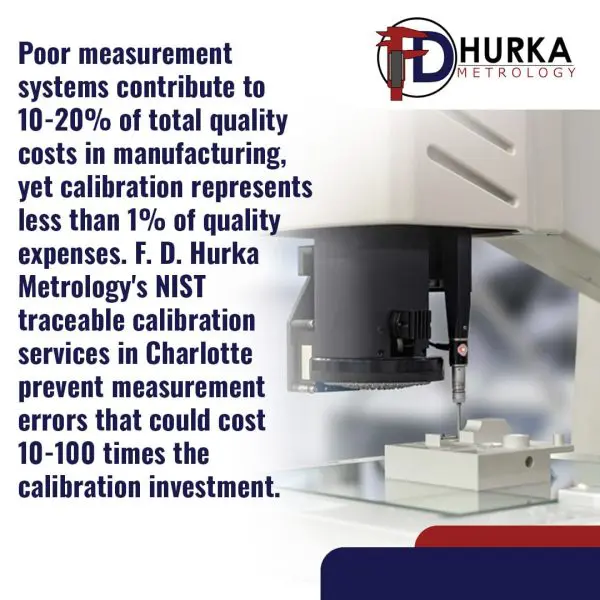
According to the American Society for Quality, poor measurement systems contribute to 10-20% of total quality costs in manufacturing operations. Proper calibration reduces these costs by preventing measurement-related errors before they impact production.
Return on Investment
Calibration costs typically represent less than 1% of total quality expenses. However, proper calibration prevents measurement errors that could cost 10-100 times the calibration investment. This favorable ratio makes calibration one of the most cost-effective quality investments.
Our NIST traceable calibration services in NC provide exceptional value by preventing costly quality problems. The documented accuracy we provide protects your reputation and bottom line.
Regulatory Compliance Support
Traceable calibrations satisfy regulatory requirements across multiple industries, including FDA, FAA, and ISO standards. These regulations mandate documented measurement traceability for product approval and market access.
FDA 21 CFR Part 820 requires medical device manufacturers to calibrate measurement equipment using traceable standards. ISO 17025 laboratory accreditation demands measurement traceability for testing services. These requirements create legal obligations for proper calibration.
Audit Preparation
Regulatory audits examine calibration records and traceability documentation. Auditors verify calibration certificates, reference appropriate standards, and include uncertainty statements. Missing or inadequate calibration records result in audit findings and potential compliance issues.
F.D. Hurka Metrology provides the thorough documentation that regulatory audits require. Our NIST traceable calibration services deliver certificates that include all necessary information to satisfy the most demanding compliance requirements.
Choosing a Calibration Provider
Select calibration providers with accredited laboratories, documented procedures, and appropriate measurement capabilities for your applications. Provider qualification directly impacts the validity of your measurement traceability chain.
Look for ISO 17025 accreditation covering the specific measurements you require. Verify the laboratory’s scope of accreditation includes your gage block sizes and accuracy requirements. Review sample calibration certificates to be certain of proper documentation standards.
F.D. Hurka Metrology Advantages
We maintain A2LA accreditation for dimensional measurements, including gage blocks. Our laboratory meets strict quality standards for measurement accuracy and documentation. Twenty-four years of calibration experience deliver reliable service delivery.
Our location in Charlotte provides convenient service throughout North Carolina and the surrounding states. Our metrology traceability services in Charlotte deliver quick turnaround times that minimize equipment downtime while maintaining calibration intervals. Competitive pricing makes quality calibration affordable for all manufacturers.
Implementation Best Practices
Establish written procedures for calibration scheduling, equipment handling, and record keeping to maintain traceability integrity. These procedures guarantee calibration effectiveness and regulatory compliance throughout your organization.
Create calibration schedules based on usage patterns and accuracy requirements. Train personnel on proper gage block handling and storage procedures. Maintain calibration records for the full equipment lifecycle, including retirement and replacement.
Document calibration intervals and approval authorities in your quality manual. Establish procedures for handling out-of-tolerance conditions and impact assessments. These systems protect measurement integrity across your operations.
Secure Your Measurement Future
Gage block calibration creates the measurement foundation modern manufacturing requires. F.D. Hurka Company provides the technical expertise and quality documentation your traceability needs demand. Contact us today to discuss how our NIST traceable calibration services support your quality objectives and regulatory compliance requirements.

Chuck Meredith is a military veteran with over two decades of experience at FD Hurka Metrology. Since joining the company in 1999, Chuck dedicated 20 years to sales before stepping into the role of President in January 2020. Passionate about people and service, Chuck takes pride in ensuring FD Hurka provides exceptional gaging and calibration solutions to its customers.
GET IN TOUCH
Shipping Address
Mailing Address
Phone Number
Fax Number
CONTACT
To request specific information or to have someone from the F. D. Hurka Metrology contact you, please fill out the contact form or click the button below to request a quote:
