
In precision manufacturing, small inconsistencies produce large consequences. Maintaining measurement accuracy is not optional. It is a core operational requirement for product fit, safety, and repeatable quality. The tools you depend on must deliver consistent results day after day. That consistency comes from more than the tool itself. It comes from regular calibration and long-term metrology support.
Why Ongoing Support Matters for Measurement and Quality
Accurate measurement underpins product quality and reliability. If you manufacture components to tight tolerances, even a slight measurement error can cause misfits, scrap, or costly rework. Regular calibration keeps instruments aligned to accepted standards.
At F. D. Hurka Metrology, Charlotte, NC, we provide ongoing calibration support because scheduled services preserve measurement reliability over time. We hold ISO/IEC 17025:2017 accreditation, which underpins our calibration processes and certificates.
What Calibration Means and Why You Need It
Calibration is the process of comparing a measuring instrument’s output to a known reference standard. That comparison reveals whether the instrument reads correctly. If needed, you adjust the instrument or record correction factors.
When the process is traceable to national or international standards, measurement results become more dependable. For example, traceability chains commonly reference national metrology institutes such as the National Institute of Standards and Technology. That traceability builds consistency across locations and time.
Without it, instruments gradually drift. Temperature shifts, wear, and environmental effects introduce subtle errors. Over time, those errors accumulate and lead to unacceptable deviations. This process is fundamental for maintaining precision, repeatability, and quality in manufacturing processes.
What Is ISO 17025-Accredited Calibration and Why It Matters
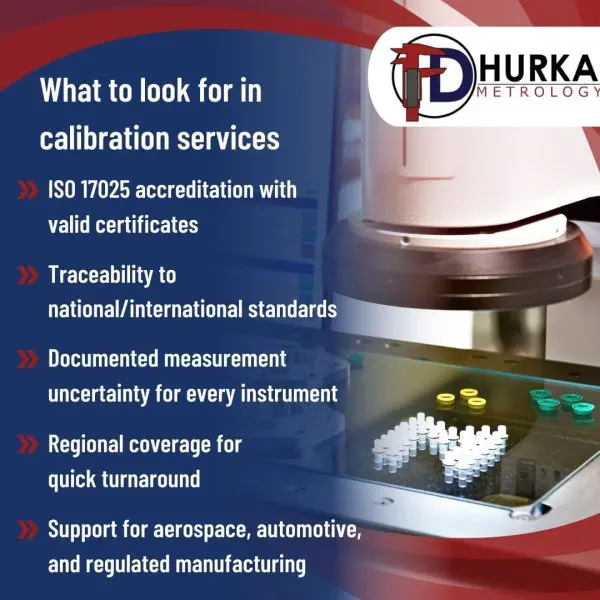
ISO 17025-accredited calibration refers to work performed in a laboratory that meets the requirements specified by the standard ISO/IEC 17025. That accreditation proves the lab is competent to deliver valid, traceable results under a recognized quality management system.
Accredited calibration builds confidence by providing documented certificates that include measurement uncertainty and scope. That documentation helps you meet regulatory, audit, and customer requirements.
We deliver ISO 17025-accredited calibration to give you measurement integrity you can rely on.
Why Ongoing Calibration Support Improves Manufacturing Outcomes
Preventing Drift and Measurement Error Over Time
Calibration services done at regular intervals catch measurement drift before it affects production. This protects you from defects or non‑conforming parts.
When instruments drift out of spec, parts may look correct but fail to meet design tolerances. Regular accredited calibration helps prevent that risk.
Maintaining Repeatability and Consistency Across Batches
With calibration, you preserve repeatability, whether you measure today, next month, or next year. That supports consistent quality across batches and production cycles.
Repeatable measurements strengthen quality control, reduce scrap, and build confidence in manufacturing processes.
Supporting Compliance, Audits, and Traceability
Many industries require documented records for quality audits, regulatory compliance, or customer guarantees. Accredited calibration services provide traceable documentation, including measurement uncertainty and calibration certificates. That documentation supports audits, compliance, and customer trust.
Extending Instrument Life and Protecting Your Investment
Calibration helps you monitor instrument performance over time. You catch wear, environmental effects, or drift before instruments fail or produce unreliable data.
That long-term support helps protect your investment in measurement equipment.
What Ongoing Calibration Support Looks Like in Practice
At F. D. Hurka Metrology, we offer a full lifecycle service for precision measurement tools. We provide:
- A schedule for regular calibration based on usage, instrument type, and criticality.
- Documented calibration certificates with uncertainty values and traceability statements.
- Traceability links to national standards, following accepted metrology practices.
- Recommendations for calibration intervals and instrument maintenance.
- Rapid response and support across our service region.
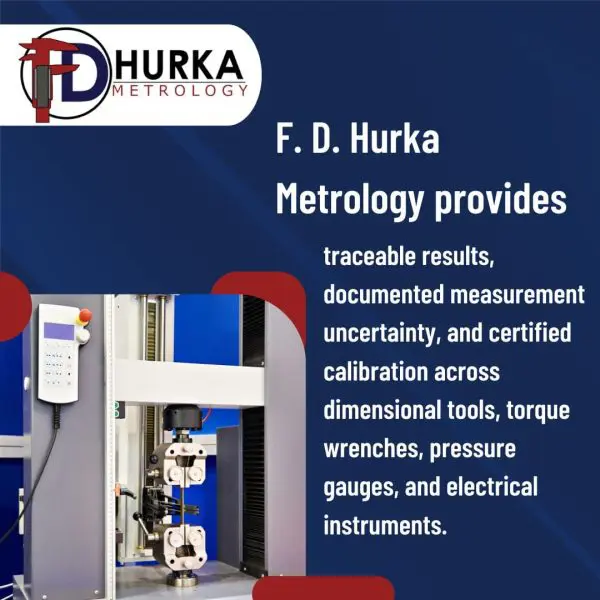
We offer calibration services for a broad range of equipment, including dimensional tools such as micrometers and calipers, torque wrenches, pressure gauges, force measurement devices, and electrical instruments. We provide both in-house calibration at our Charlotte lab and on-site calibration at customer facilities.
Industries such as aerospace, automotive, heavy machinery, and other regulated manufacturing sectors benefit from accredited calibration and traceable documentation. If you need calibration for highly regulated sectors, confirm any additional approvals or contract requirements with the provider.
Why Traceability and Measurement Uncertainty Matter
Every measurement carries some uncertainty. That uncertainty stems from the instrument, environment, user, and method used. When you receive a calibration certificate, it includes a measurement uncertainty value. That value helps you understand how much confidence to place in each measurement.
Traceability means your measurements link back to recognized standards through a documented chain. That connection makes them globally comparable and legally defensible when needed.
Accredited services deliver both traceability and quantifiable uncertainty, giving you and your customers confidence in the results. This level of documentation supports compliance, audit readiness, and consistent quality across all locations.
Real-World Examples: When Calibration Prevents Costly Failures
Consider a manufacturer producing parts for the automotive industry. A caliper is used to measure shaft diameters with tight tolerance. Without regular calibration, that caliper may drift by a few microns. Over thousands of parts, a small drift could result in many shafts that do not meet spec. Quality rejects, or rework, would increase production costs substantially.
With scheduled calibration, you identify drift early, correct the reading, and ensure all shafts fall within tolerance. That saves costs and maintains customer satisfaction.
In another scenario, a facility uses torque wrenches for the assembly of heavy equipment. If the wrench calibration is outdated, torque values may be inaccurate. That can lead to improper assembly, structural weakness, or mechanical failure. Regular calibration ensures torque readings remain accurate, preserving safety and reliability.
These real-world examples show that precise measurement isn’t just about theory; it directly impacts quality, safety, and cost.
Why Calibration Services Near You Make a Difference
When you search for calibration services near you, time and convenience matter, a provider close to you can reduce turnaround time, minimize downtime, and respond faster to urgent calibration needs.
At F. D. Hurka Metrology, we provide services throughout Alabama, Florida, Georgia, Louisiana, Mississippi, North Carolina, South Carolina, Tennessee, & Virginia. That broad coverage guarantees you have access to accredited calibration and support in your region without long delays.
Local availability combined with accredited calibration gives you reliable support when and where you need it.
How to Choose the Right Calibration Partner
When you evaluate a calibration provider, consider if they:
- Offer ISO 17025-accredited calibration or equivalent recognized accreditation.
- Provide documentation with measurement uncertainty, calibration date, instrument ID, and traceability statement.
- Use traceable standards linked to a recognized national metrology institute (for example, standards following guidelines of the National Institute of Standards and Technology (NIST)).
- Support a wide range of instrument types for your operation.
- Offer timely calibration services and responsive customer support.
- Cover your geographic region so you can access calibration services near you.
If a provider cannot meet these criteria, measurement results may not be credible, reliable, or acceptable for audits.
At F. D. Hurka Metrology, we meet all these criteria. We deliver accredited calibration, documentation, traceability, and service coverage across our region.
Research-Backed Value of Traceable Calibration in Manufacturing
The NIST defines metrological traceability as a property of a measurement result where the result can be related to a reference through a documented, unbroken chain of calibrations, each contributing to measurement uncertainty.
Traceability ensures measurement results remain comparable across time and different locations. That consistency supports safety, quality control, regulatory compliance, and reliable manufacturing outcomes.
The benefits of ongoing calibration go beyond a single measurement. They support long‑term quality, reduce waste, lower rework rates, and build confidence in manufacturing precision.
How to Set Up an Ongoing Calibration Plan
To get maximum value from calibration and avoid measurement drift, you should have a formal plan. Here are the key steps:
- List all measurement instruments and categorize them by criticality, usage frequency, and tolerances required.
- Determine calibration intervals based on instrument type, frequency of use, environment, and accuracy requirements.
- Record baseline calibration results, measurement uncertainty, and traceability data.
- Schedule regular calibration (for example, annually or more frequently for high‑use instruments).
- Maintain calibration certificates, documentation, and uncertainty records for audit and compliance.
- Review instrument performance and consider maintenance or replacement when drift or excessive uncertainty occurs.
- Work with a calibration partner that offers accredited calibration, traceability, and fast turnaround.
With such a plan, you transform calibration from a reactive task into a proactive strategy for consistent quality and compliance.
We help you build and manage such plans. We offer calibration services, documentation, scheduling, and guidance. We keep calibration records so your audit trail stays intact and your measurement systems stay valid.
Customer Feedback That Shows Real Value
The impact of our calibration services is best expressed by those who rely on them every day:
“Best metrologist ever!” — Ronnie P.
“Amazing customer service. Always helpful and quick responses. Their prices are hard to beat too. One of the best calibration houses we have used. Highly recommend them.” — Eric C.
These voices speak to the trust we’ve earned through accurate results, fast turnaround, and real support when it matters most. At F. D. Hurka Company, we do more than perform calibrations. We build long-term relationships based on reliability and measurable value.
Why You Should Consider Ongoing Support Instead of One-Time Calibration
One‑time calibration may fix immediate errors. But it does not protect you from long-term drift, wear, or environmental effects. Ongoing support with scheduled calibration and accredited calibration services gives you long-term measurement integrity. You get traceability, uncertainty documentation, consistent quality, audit readiness, and peace of mind. That approach reduces scrap, avoids rework, lowers liability risk, and supports long-term reliability.
How F. D. Hurka Metrology Delivers Value for Your Operation
We offer a complete calibration solution. We deliver:
- Accredited calibration for regulated industries.
- Calibration services for a wide range of instruments used in manufacturing, testing, and quality control.
- Documentation that includes uncertainty, traceability, calibration dates, and instrument data.
- A regional footprint offering calibration services in North Carolina and the surrounding regions.
- Scheduling, support, and responsive customer service to help you maintain measurement integrity.
We act as your partner, not just a vendor. We help you integrate calibration into your quality management plan. We help you avoid risk, reduce waste, and maintain consistent quality across production batches.
Ongoing Support Saves Cost and Protects Quality
Ongoing calibration support does more than keep tools in check; it safeguards your entire manufacturing process. You maintain accuracy, protect repeatability, and avoid costly defects or compliance issues. You also extend the life of your equipment and uphold the quality your customers expect.
F. D. Hurka Metrology delivers more than calibration. We bring accredited services, clear documentation, trusted traceability, and support you can count on.
If precision, quality, and reliability are non-negotiable in your operation, we’re ready to help. Let’s create a calibration plan that fits your equipment, your schedule, and your standards.
Contact us today, and keep your measurements working as hard as you do. F. D. Hurka Metrology, Measuring Up To Your Expectations Since 1970.

Chuck Meredith is a military veteran with over two decades of experience at FD Hurka Metrology. Since joining the company in 1999, Chuck dedicated 20 years to sales before stepping into the role of President in January 2020. Passionate about people and service, Chuck takes pride in ensuring FD Hurka provides exceptional gaging and calibration solutions to its customers.
GET IN TOUCH
Shipping Address
Mailing Address
Phone Number
Fax Number
CONTACT
To request specific information or to have someone from the F. D. Hurka Metrology contact you, please fill out the contact form or click the button below to request a quote:
