

Precision manufacturers across the Southeast have long relied on contact-based gages and instruments to verify part dimensions. These tools have earned their place on the shop floor. But as parts grow more complex and tolerances tighter, many quality teams are asking a different question: when does a vision system do the job better? At F. D. Hurka Metrology, we work with manufacturers daily on this exact decision. This article lays out a clear, factual comparison between contact and non-contact type measuring instruments and methods, so you can make the right call for your inspection needs.
Choosing between contact and non-contact measurement is not about which method is newer. It is about which method fits the part, the process, and the production volume. Both approaches have earned their place in modern metrology. The difference lies in knowing when each one performs best.
What Are Contact Measurement Tools?
Contact measurement tools gather data by physically touching the part surface with a probe, stylus, or gage element.
Common examples include:
- Calipers and micrometers
- Height gages
- Plug and ring gages
- Coordinate measuring machines (CMMs) with touch probes
- Dial indicators
These tools are reliable, well-understood, and widely used across manufacturing industries. They work by detecting the physical boundary of a surface through mechanical contact. This makes them well-suited for solid, rigid parts where surface deformation is not a concern.
What Are Optical Measuring Instruments?
Optical measuring instruments capture part dimensions using light, cameras, and image processing, with no physical contact required.
Non-contact measurement uses technologies such as:
- Vision systems (video measuring machines)
- Laser displacement sensors
- Structured light scanners
- Optical comparators
An optical measurement machine projects an image of the part, detects edges and features, and calculates dimensions based on that image data. The part is never touched during the measurement cycle.
At F. D. Hurka Metrology, we offer Micro-Vu vision systems as part of our product line. Micro-Vu builds automated and manual precision measurement systems, field-of-view systems, and metrology software. Their InSpec software receives free updates, keeping your system current without added cost.
Comparison Between Contact and Non-Contact Type Measuring Instruments
This is the question most quality managers face when adding new inspection capability. Here is a direct comparison across the factors that matter most in production environments.
Measurement Speed
Non-contact measurement is faster for high-volume inspection.
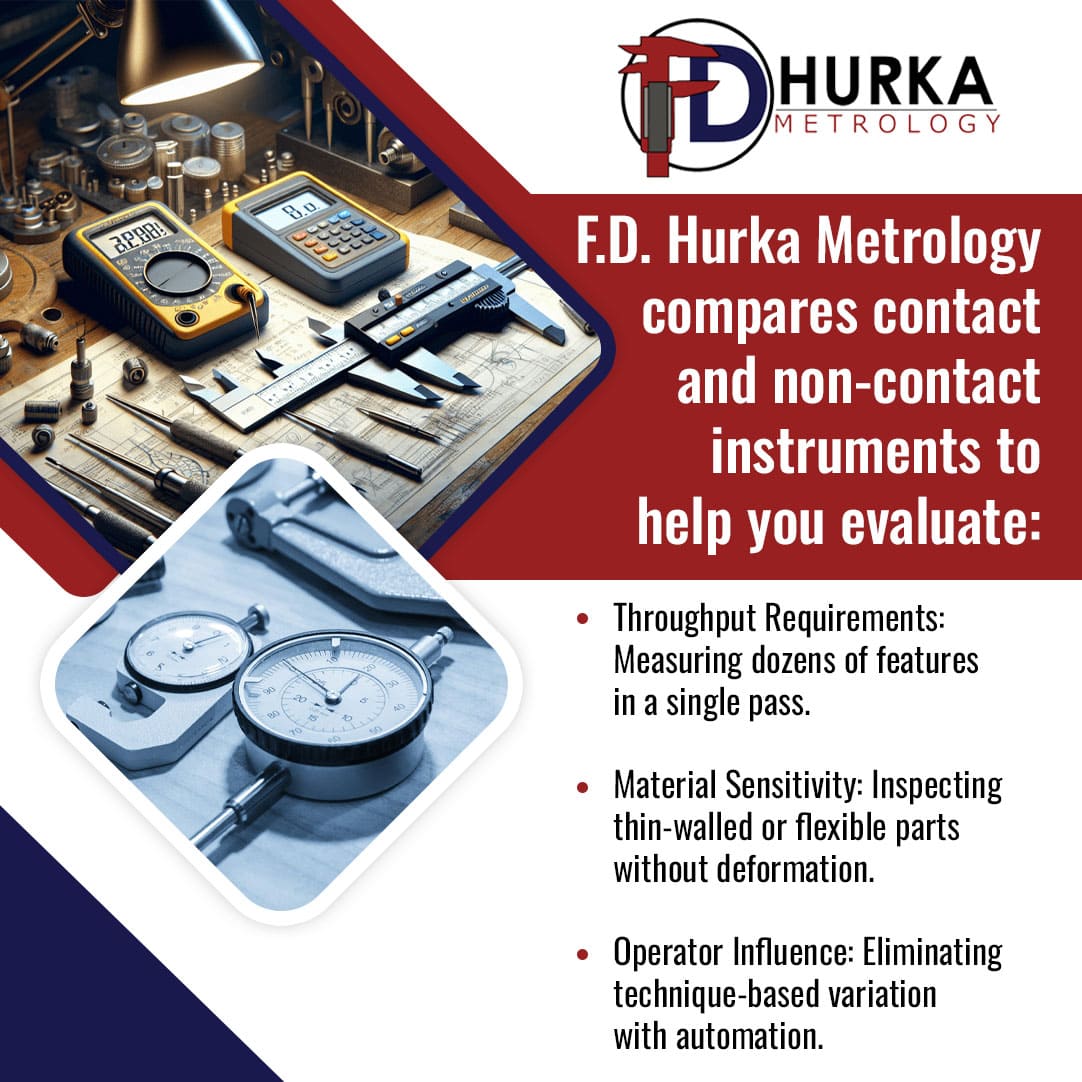
A vision system can measure dozens of features in a single image capture. A contact probe measures one point at a time. With 20 or more features to check, an optical measurement machine can reduce cycle time dramatically compared to a touch-probe CMM or manual gage.
For a machined bracket requiring 25 dimensional checks, a vision system may complete the inspection in under a minute. The same inspection using a CMM with a touch probe could take several minutes per part.
Part Type and Material
Contact methods are preferred for opaque, rigid, and geometrically simple parts. Non-contact measurement is preferred for flexible, delicate, or thin-walled components.
A soft rubber gasket, a thin plastic film, or a fragile medical component can deform under the pressure of a contact probe. The measurement result then reflects the deformed state, not the true dimension. An optical measurement tool captures the part as-is, without introducing any force.
According to NIST’s Technology Partnerships Office, non-contact measurement eliminates errors caused by physical contact, such as deformation or contamination, making it particularly useful in industries requiring high-precision measurements of delicate or complex surfaces.
Feature Accessibility
Optical measuring instruments can measure features that a contact probe physically cannot reach.
Fine edges, small holes, thin slots, and surface features on fragile substrates are often impossible to contact without risking damage or inaccurate readings. A vision system captures these features through imaging, without any risk to the part or the tool.
Operator Influence
Vision systems reduce operator-to-operator variation.
Contact measurements, especially with handheld gages, depend on the technique, force, and positioning skill of the operator. Two technicians measuring the same part with the same micrometer can record different values. Non-contact measurement with an automated optical measurement machine removes this variable. The measurement program runs the same way every time.
Surface Finish and Reflectivity
Contact methods often outperform non-contact measurement on highly reflective or transparent surfaces.
Shiny metal surfaces, polished glass, and clear plastics can create challenges for optical measurement tools. The camera may struggle to detect edges accurately when light reflects unpredictably from the surface. In these cases, a touch probe or CMM delivers more reliable results.
This is a practical limitation to weigh honestly. Not every part is a good candidate for non-contact measurement.
Data Volume
Optical measurement machines generate far more data points per inspection cycle.
A contact CMM collects data at each programmed touch point. A vision system or structured light scanner can capture thousands of points across an entire surface in a single pass. This higher data density supports better statistical analysis, tighter process control, and faster defect detection.
A recent review of optical metrology techniques for advanced manufacturing noted that optical methods offer key advantages such as high precision, non-contact operation, and rapid response, while supporting measurement needs across a wide range of scales.
When Vision Systems Outperform Contact Tools
Here are specific scenarios where an optical measurement tool delivers a clear advantage over contact-based methods.
Small, delicate components. Medical implants, electronic connectors, and micro-machined parts often cannot withstand contact force. A vision system inspects these without risk.
High-mix, high-volume production. When part types change frequently, a vision system with a programmable measurement routine switches setups faster than reprogramming a CMM or changing physical gages.
Complex 2D profiles. Parts with curved edges, complex contours, or many closely spaced features are measured more efficiently with a non-contact measurement system that captures the full profile in one pass.
In-line inspection. Optical measurement machines can be integrated into production lines for real-time measurement without stopping the flow of parts. Contact-based tools are harder to integrate in-process.
Soft or deformable materials. Rubber, foam, textile, and thin-wall plastic parts are measured accurately with non-contact methods. Contact tools introduce measurement error by altering the part shape under the probe force.
When Contact Tools Still Win
Non-contact measurement is not the answer for every application. Contact tools remain the better choice in these situations.
- Highly reflective or transparent surfaces where optical edge detection is unreliable
- Deep bores and internal features where line-of-sight imaging is not possible
- Single-feature spot checks, where a handheld gage is faster and more practical
- Hardness testing and force-dependent measurements that require physical engagement with the surface
A well-equipped inspection lab uses both methods. The goal is to select the right tool for the right part feature.
What Your Quality Team Needs to Know
Can a vision system replace a CMM entirely?
No, a vision system does not replace a CMM in most facilities. The two tools serve different purposes. A CMM with a touch probe excels at 3D measurements, deep features, and hard-to-image geometries. A vision system excels at 2D profiles, high-volume inspection, and delicate parts. Most manufacturers benefit from having both.
How accurate are optical measuring instruments compared to contact tools?
Both methods can achieve high accuracy when used correctly and on appropriate part types. Contact CMMs have long been the benchmark for dimensional accuracy. Modern optical measurement machines have closed the gap significantly, particularly for surface features, edges, and 2D geometry. Accuracy depends heavily on calibration, environmental control, and part suitability.
Does non-contact measurement still require calibration?
Yes. Optical measurement machines require regular calibration, just like contact tools. An optical measurement tool must be calibrated to a traceable standard to produce results that are metrologically valid. Calibration intervals depend on use frequency, manufacturer recommendations, and your quality system requirements. F. D. Hurka Company provides ISO/IEC 17025-accredited calibration services for measurement instruments, including calibration performed in our temperature and humidity-controlled laboratory or at your facility through our on-site calibration service.
What does it mean for a vision system to be “field of view” based?
A field-of-view system measures the entire part or zone in a single captured image, rather than moving to each feature one at a time. This approach is faster for parts with many features clustered in one area. Micro-Vu, whose products F. D. Hurka Metrology distributes across nine Southeastern territories, offers field-of-view systems designed for exactly this type of inspection challenge.
Choosing the Right Measurement Strategy for Your Operation
The decision to add an optical measurement tool is not simply a technology choice. It reflects the complexity of your parts, the throughput demands of your line, and the calibration support behind your instruments.
At F. D. Hurka Metrology, we help manufacturers in Charlotte, NC, and across the Southeast match the right measurement technology to their inspection requirements. Whether you are evaluating Micro-Vu vision systems, need ISO/IEC 17025-accredited calibration for your existing instruments, or want hands-on training for your quality team, our team is ready to help. Contact us to discuss your measurement needs.

Chuck Meredith is a military veteran with over two decades of experience at FD Hurka Metrology. Since joining the company in 1999, Chuck dedicated 20 years to sales before stepping into the role of President in January 2020. Passionate about people and service, Chuck takes pride in ensuring FD Hurka provides exceptional gaging and calibration solutions to its customers.
GET IN TOUCH
Shipping Address
Mailing Address
Phone Number
Fax Number
CONTACT
To request specific information or to have someone from the F. D. Hurka Metrology contact you, please fill out the contact form or click the button below to request a quote:
