

Manufacturing operations depend on accurate measurement systems to maintain quality standards and production efficiency. Modern CMM calibration maintains measurement accuracy over years of continuous operation through systematic verification and adjustment procedures. Regular calibration services protect your investment while preventing costly production errors that result from measurement drift.
F. D. Hurka Metrology in Charlotte, NC, has observed how proper CMM maintenance directly impacts manufacturing outcomes across diverse industries. Our calibration specialists work with coordinate measuring machine manufacturers and end-users to establish maintenance schedules that maximize equipment performance. The measurement data quality you achieve today depends entirely on the calibration protocols you implement throughout your CMM’s operational life.
Understanding CMM Measurement Stability
Coordinate measuring machines require consistent environmental conditions and regular maintenance to deliver reliable results. Temperature fluctuations, mechanical wear, and probe degradation gradually reduce measurement accuracy without proper attention. Your CMM products represent substantial capital investments that demand systematic care to preserve their value.
Manufacturing facilities often underestimate how environmental factors affect coordinate measuring machine performance. Air pressure changes, vibration from nearby equipment, and thermal expansion influence measurement consistency. F. D. Hurka Metrology conducts environmental evaluations alongside calibration services to identify factors that compromise accuracy.
Critical Calibration Components
Probe System Verification
CMM probe systems require frequent attention because they experience direct contact with measured parts. Probe tip wear occurs gradually and will reduce repeatability. Industry practice is to perform probe qualification using certified reference spheres and multi-orientation checks. Documented probe performance helps predict stylus replacement and prevents unnoticed measurement drift.
Our technicians document probe performance characteristics during each calibration cycle. This data helps predict when probe replacement becomes necessary and prevents measurement errors from developing unnoticed.
Machine Geometry Assessment
Coordinate measuring machines rely on precise geometric relationships between axes to calculate part dimensions accurately. Machine geometry errors accumulate over time due to mechanical wear and structural settling.
The calibration process includes thorough geometry checks using certified artifacts. These measurements reveal how machine accuracy changes and guide compensation adjustments that restore performance specifications.
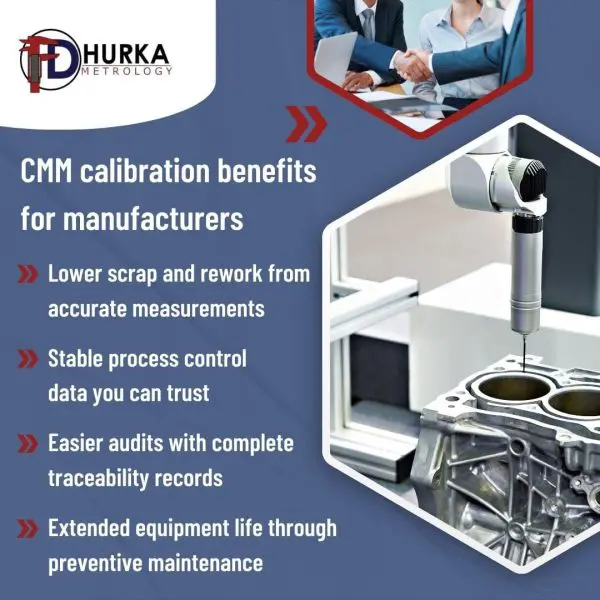
Calibration Frequency Guidelines
Calibration frequency should be set based on usage, criticality, and environmental stability rather than a universal schedule. Typical approaches include:
- High utilization or production-critical CMMs: Evaluate monthly or perform short functional checks frequently and full calibrations more often than annual, depending on hours of operation.
- Standard manufacturing: Many facilities perform full calibrations on a quarterly or annual basis, guided by manufacturer recommendations and quality system needs.
- Laboratory/inspection environments: Controlled labs often use semi-annual or annual full calibrations, supplemented by periodic verification artifacts.
- Light duty or low risk: Annual calibration may be sufficient for occasional use.
Where possible, use a mix of in-house checks and third-party full calibrations. Some manufacturers and service providers use an hours-based rule of thumb, for example, 2000 operating hours as a starting reference for full calibration planning, but adapt that to the actual environment and risk profile.
Environmental conditions and measurement criticality influence these recommendations. We work with customers to establish calibration schedules that balance cost considerations with measurement requirements.
Industry-Specific Reliability Requirements
Automotive Manufacturing
Automotive suppliers face stringent quality requirements that demand exceptional CMM reliability. Parts per million defect rates require measurement systems capable of detecting variations within tight tolerance bands. Coordinate measuring machine manufacturers design automotive-grade systems with enhanced repeatability specifications.
F. D. Hurka Metrology calibrates CMMs used for engine block inspection, transmission component verification, and safety-critical part measurement. These applications cannot tolerate measurement uncertainty that compromises product quality.
Aerospace Applications
Aerospace components require measurement traceability that meets federal regulations and industry standards. CMM calibration for aerospace applications includes documentation that supports quality system audits and certification processes.
Our ISO/IEC 17025 calibration certificates include traceability statements referencing national standards and include uncertainty calculations. When required, this establishes NIST traceability through the laboratory’s calibration chain and supports aerospace quality-system audits.
Temperature Compensation Strategies
Thermal effects are commonly one of the largest contributors to CMM measurement error. Small changes in ambient or part temperature cause thermal expansion or contraction in the machine structure and the workpiece, which alter machine geometry and measured dimensions. Modern calibration practices, therefore, include thermal evaluation and temperature compensation plans.
Effective temperature compensation requires knowing how your specific CMM responds to thermal conditions. F. D. Hurka Metrology measures temperature coefficients for individual machines and adjusts compensation parameters accordingly.
Modern CMM products include sophisticated temperature monitoring systems that track ambient conditions and part temperatures. However, these systems require calibration to function properly and deliver accurate corrections.
Preventive Maintenance Integration
CMM calibration works most effectively when integrated with robust preventive maintenance programs. Regular cleaning, lubrication, and component inspection prevent problems that calibration cannot correct.
Our maintenance recommendations include:
- Daily cleaning procedures that protect sensitive components
- Weekly lubrication schedules for moving elements
- Monthly air pressure and filter inspections
- Quarterly probe system evaluations
- Annual comprehensive system inspections
Coordinate measuring machine manufacturers provide detailed maintenance guidelines that complement calibration schedules. Following both programs together maximizes equipment reliability and measurement accuracy.
Cost Impact of Calibration Neglect
Manufacturing operations that defer CMM calibration face escalating costs as measurement accuracy degrades. Parts rejected due to measurement errors cost substantially more than proper calibration services.
We have documented cases where calibration deferrals resulted in:
- Production delays, while the measurement systems were restored
- Increased scrap rates due to false rejections
- Customer complaints about dimensional variations
- Regulatory compliance issues requiring extensive corrective actions
Research and industry analyses show that rework and scrap costs can be high and often exceed the direct costs of parts because of lost capacity, additional labor, and schedule disruption. For example, a manufacturing cost study published in JMEST documents high rework and scrap costs in an industry case study. For a broader industry context, consult recognized Cost of Poor Quality studies and whitepapers that quantify COPQ as a material percent of revenue in many operations.
Documentation and Traceability
CMM calibration generates documentation that supports quality system requirements and customer audits. Calibration certificates provide measurement traceability that links your results to national standards.
Our calibration process includes:
- Before and after measurement data comparing system performance
- Uncertainty calculations that quantify measurement reliability
- Environmental condition records during calibration procedures
- Recommended corrective actions when performance deviates from specifications
Quality systems like ISO 9001 and AS9100 require measurement equipment calibration with documented traceability. F. D. Hurka Metrology provides certificates that meet these requirements and support customer quality audits.
Advanced Calibration Technologies
Modern CMM calibration employs laser interferometry and precision artifacts that exceed traditional measurement capabilities. Laser-based calibration systems can deliver sub-micron and even nanometer-class resolution for geometry measurement. For example, portable laser interferometer systems used for CMM and machine tool calibration report linear resolutions down to 1 nanometer and are commonly used to generate volumetric error maps that guide compensation.
These advanced techniques reveal performance characteristics that conventional calibration methods cannot detect. We invest in laser calibration equipment that delivers measurement capabilities exceeding most production requirements.
Selection Considerations for New CMMs
CMM selection decisions should include calibration requirements and long-term maintenance costs. Different coordinate measuring machine manufacturers design systems with varying calibration needs and service requirements.
Consider these factors during CMM selection:
- Calibration frequency recommendations from manufacturers
- Service availability in your geographic region
- Environmental condition requirements for optimum performance
- Documentation and software capabilities for calibration management
F. D. Hurka Metrology assists customers with CMM selection by evaluating calibration requirements alongside measurement capabilities. This integrated approach helps identify systems that deliver long-term reliability at acceptable operating costs.
Return on Investment Analysis
Proper CMM calibration delivers measurable returns through improved product quality and reduced manufacturing costs. Quality improvements from accurate measurements typically offset calibration expenses within months.
Manufacturing operations report these benefits from consistent calibration programs:
- Reduced scrap rates due to accurate measurements
- Decreased inspection time through reliable results
- Improved customer satisfaction from consistent quality
- Lower warranty costs through better dimensional control
Technology Integration Opportunities
Modern manufacturing systems integrate CMM data with statistical process control and enterprise resource planning systems. Calibrated measurement systems provide reliable data that supports automated decision-making and quality optimization.
F. D. Hurka Metrology helps customers implement calibration schedules that maintain data integrity throughout integrated manufacturing systems. This approach maximizes the value of measurement investments while supporting advanced manufacturing capabilities.
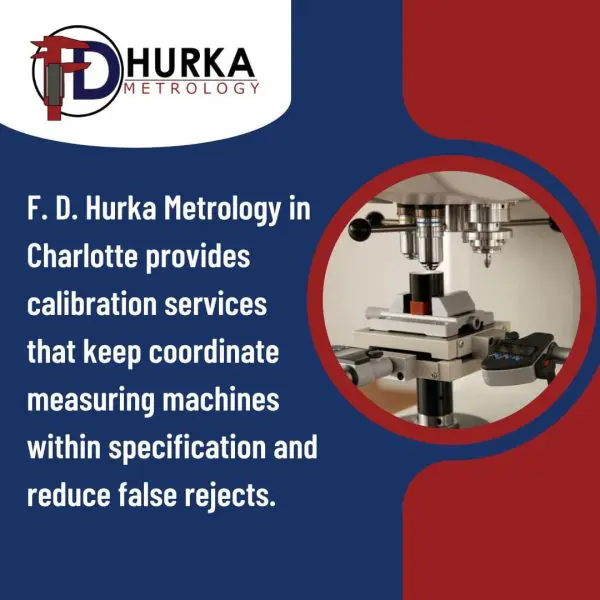
About F. D. Hurka Metrology
We have served precision measurement needs since 1970, establishing ourselves as the Southeast’s trusted calibration and metrology partner. We combine decades of experience with modern calibration technologies to deliver services that protect your measurement investments.
Our Charlotte facility is ISO/IEC 17025:2017 accredited through A2LA, and our scope covers dimensional and electrical calibration and contract dimensional measurement using CMM and vision technologies. This accreditation demonstrates traceability and competence for laboratory calibration services.
We serve manufacturing operations across nine southeastern states throughout Alabama, Florida, Georgia, Louisiana, Mississippi, North Carolina, South Carolina, Tennessee, and Virginia, offering both in-house and on-site calibration services that minimize production disruption.
Our calibration capabilities include coordinate measuring machines from all major manufacturers, dimensional measuring tools, and precision gaging equipment. We maintain traceability to national standards while providing fast turnaround times that keep your operations running smoothly.
Frequently Asked Questions
- How often should our CMM receive calibration? Most manufacturing applications benefit from quarterly calibration schedules, though usage intensity and accuracy requirements may justify more frequent service.
- What happens if we skip scheduled calibrations? Measurement accuracy gradually degrades, leading to increased scrap rates, customer complaints, and potential regulatory compliance issues.
- Can we perform CMM calibration internally? Internal calibration requires specialized equipment, certified reference standards, and trained technicians. Most organizations find external calibration services more cost-effective.
- How long does a typical calibration take? Calibration duration varies by machine size, scope, and whether only a verification or a full certification plus preventive maintenance is required. Simple on-site verifications can be completed in a half-day. Typical full calibrations commonly require between 4 and 16 hours. For large CMMs or when volumetric error mapping and preventive maintenance are included, plan for one to two days or longer.
Our commitment to measurement excellence drives everything we do. We understand how calibration quality affects your manufacturing success and work diligently to provide services that support your operational goals.
Protecting Your Measurement Investment
CMM calibration represents a fundamental investment in manufacturing quality and operational efficiency. The measurement accuracy you maintain today determines product quality, customer satisfaction, and competitive advantage tomorrow. Regular calibration schedules protect coordinate measuring machine investments while preventing costly production errors that result from measurement drift.
F. D. Hurka Company understands how critical measurement accuracy becomes in today’s competitive manufacturing environment. Our calibration services combine technical expertise with practical knowledge of production requirements. We work with you to establish maintenance schedules that maximize CMM performance while minimizing operational disruption.
Manufacturing success depends on reliable measurement systems that deliver consistent results over years of operation. Contact us today to discuss calibration schedules that protect your investment and maintain the accuracy your operations demand. Our team stands ready to support your measurement quality goals with services that reflect over five decades of metrology experience.

Chuck Meredith is a military veteran with over two decades of experience at FD Hurka Metrology. Since joining the company in 1999, Chuck dedicated 20 years to sales before stepping into the role of President in January 2020. Passionate about people and service, Chuck takes pride in ensuring FD Hurka provides exceptional gaging and calibration solutions to its customers.
GET IN TOUCH
Shipping Address
Mailing Address
Phone Number
Fax Number
CONTACT
To request specific information or to have someone from the F. D. Hurka Metrology contact you, please fill out the contact form or click the button below to request a quote:
