

A single measurement error can result in rejected parts, production delays, and thousands of dollars in waste. Manufacturing teams across the country face this reality daily when their metrology equipment fails to match application requirements. Selecting the right metrology tools requires matching instrument capabilities to specific measurement tasks, tolerance requirements, and production environments. F. D. Hurka Metrology has guided manufacturers through this selection process since 1970, helping companies across Alabama, Florida, Georgia, Louisiana, Mississippi, North Carolina, South Carolina, Tennessee, and Virginia find precision instruments that deliver reliable results.
The difference between adequate and excellent measurement capability often determines whether a quality program succeeds or struggles. From hand-held calipers to advanced coordinate measuring machines, each category of metrology equipment serves distinct purposes. Being aware of these distinctions helps manufacturing professionals make informed purchasing decisions that support long-term quality objectives.
What Defines the Right Metrology Tool?
The right metrology tool measures your specific feature within required tolerances while fitting your production workflow. This definition sounds simple, but it involves multiple considerations that many purchasing teams overlook.
According to NIST Technical Note 1297, measurement uncertainty characterizes the dispersion of values that could reasonably be attributed to the measurand. This uncertainty must be small enough relative to your tolerance requirements to make reliable pass/fail decisions. The industry standard known as the Test Uncertainty Ratio (TUR) recommends that calibration uncertainties should not exceed 25% of acceptable tolerance, translating to a 4:1 ratio between tolerance and measurement uncertainty.
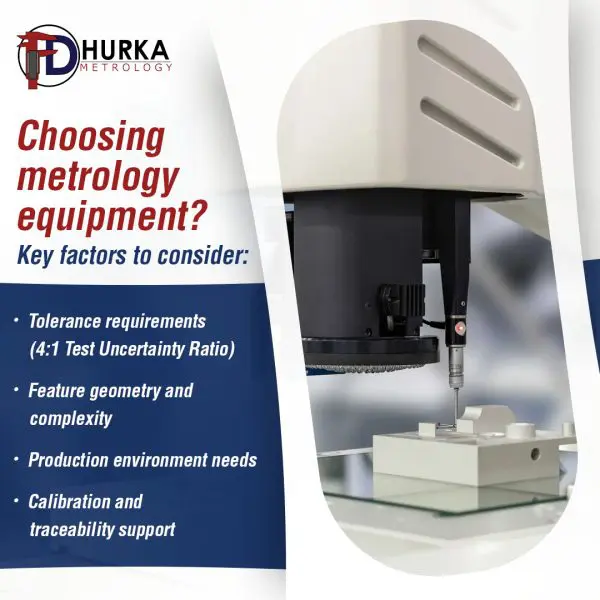
Key Factors in Tool Selection
When evaluating metrology equipment for your facility, consider these factors:
- Tolerance requirements determine minimum instrument resolution and accuracy
- Feature geometry dictates whether contact or non-contact methods work better
- Production volume affects whether manual or automated systems provide better value
- Environmental conditions influence which instrument types maintain stability
- Operator skill levels determine training requirements and measurement repeatability
Understanding Metrology Equipment Categories
F. D. Hurka Metrology distributes precision instruments across multiple categories. Each serves specific application ranges and measurement challenges.
Hand-Held Gages
Hand-held gages include calipers, micrometers, and dial indicators. These metrology tools provide portability and quick measurements for shop-floor verification. Digital versions offer direct readings that reduce interpretation errors.
Calipers measure inside, outside, and depth dimensions. Standard calipers resolve to 0.001 inches or 0.01mm. Micrometers provide higher resolution, typically 0.0001 inches, making them suitable for tighter tolerances. Both instruments require proper technique to achieve their stated accuracy.
When are hand-held gages appropriate? Use hand-held precision instruments when tolerances exceed ±0.001 inches and when portability matters more than automation. These tools work well for incoming inspection, setup verification, and first-article checks.
Coordinate Measuring Machines (CMM)
CMMs represent the standard for dimensional inspection in manufacturing. These machine measurement tools use tactile probes or optical sensors on a three-axis coordinate system. F. D. Hurka Metrology partners with Mitutoyo to provide CMM solutions across the Southeast from our Charlotte, NC headquarters.
CMMs excel at measuring complex geometries with multiple features. A single program can inspect dozens of dimensions, calculating geometric tolerances like flatness, perpendicularity, and true position. This capability makes CMMs indispensable for aerospace, automotive, and medical device manufacturing.
The trade-off involves speed and cost. CMM inspection takes longer than dedicated gaging. Purchase and maintenance costs exceed those of simpler instruments. However, the flexibility to measure virtually any geometry often justifies these investments for facilities producing varied parts.
Vision Systems
Vision systems use high-resolution cameras to capture part images for dimensional analysis. Micro-Vu systems combine optical measurement with touch probes and laser sensors for maximum flexibility.
Vision systems provide non-contact measurement, ideal for delicate, soft, or highly polished materials. Parts that would deform under probe contact require optical methods. Electronic components, medical devices, and thin-wall parts often fall into this category.
These high-precision measuring tools capture multiple features simultaneously, improving throughput compared to single-point contact methods. Edge detection algorithms measure features that lack distinct surfaces for probe contact. The combination of speed and non-contact capability makes vision systems valuable for high-volume production environments.
Automated Gaging
Automated gaging systems measure parts during or immediately after production. These machine measuring tools integrate with manufacturing equipment to provide real-time feedback. Edmunds automated gaging solutions serve manufacturers requiring 100% inspection.
Unlike CMM inspection, which samples production, automated gaging checks every part. This capability catches drift before significant scrap accumulates. Statistical processes control data streams directly from gaging stations to quality management systems.
Automated gaging delivers the highest value when production volumes justify the investment and when the cost of missed defects exceeds equipment costs. Automotive component suppliers frequently use automated gaging to meet customer quality requirements.
X-ray CT Systems
X-ray computed tomography (CT) systems inspect internal features without destroying parts. RX Solutions systems scan entire parts to create 3D models for dimensional analysis.
CT inspection reveals internal geometries, assembly relationships, and material defects invisible to surface measurement methods. Additive manufacturing, casting, and molding operations benefit from CT’s ability to verify internal quality.
Matching Tools to Application Requirements
Different manufacturing processes generate parts with varying needs for inspection. Matching metrology equipment to these needs prevents both over-specification and under-capability.
For Machined Components
Machined parts typically require dimensional verification of features like holes, slots, and surfaces. Tolerances range from loose (±0.005 inches) to tight (±0.0002 inches or tighter). The tolerance range determines appropriate measurement tools.
For looser tolerances, calibrated hand tools often suffice. Calipers verify basic dimensions quickly. As tolerances tighten, precision instruments like height gages and CMMs become necessary. These high-precision measurement tools provide the resolution and repeatability that hand tools cannot match.
For Sheet Metal and Stampings
Sheet metal parts present unique measurement challenges. Thin materials flex under probe contact. Complex contours require multiple measurement points. Part-to-part variation in formed features demands statistical approaches.
Vision systems and optical comparators measure sheet metal without inducing deformation. Profile projectors compare part shadows to tolerance overlays. CMMs with scanning probes capture surface profiles efficiently.
For Plastic and Rubber Parts
Plastic and rubber materials compress under measurement force. This compression introduces systematic errors if not accounted for. Low-force probing or non-contact methods address this challenge.
Select metrology tools with adjustable measuring force or optical measurement capability for compressible materials. Air gaging provides another option, using pneumatic principles that contact parts gently while maintaining high sensitivity.
For Assembly Verification
Assembly verification checks relationships between components. Does the shaft fit the bearing? Does the cover seal against the housing? These functional checks differ from individual part inspection.
Functional gages verify fit conditions directly. Pin gages check hole sizes. Ring gages verify shaft diameters. Go/no-go gaging provides pass/fail results without numerical readings. We supply functional gages from multiple manufacturers to support assembly verification needs.
The Role of Calibration in Tool Selection
Every measurement instrument requires regular calibration to maintain accuracy. Calibration verifies that instruments perform within specifications and provides traceability to national standards.
NIST defines metrological traceability as the property of a measurement result whereby the result can be related to a reference through a documented unbroken chain of calibrations. This traceability underpins quality system requirements across regulated industries.
When selecting metrology equipment, consider calibration requirements and costs. Some instruments require specialized calibration equipment. Others demand controlled environments. These factors affect total ownership costs beyond purchase price.
F. D. Hurka Metrology operates an A2LA-accredited calibration laboratory in Charlotte, NC. Our 3-5 day turnaround for in-house calibration minimizes equipment downtime. We also provide on-site calibration services for equipment that cannot leave production facilities.
Calibration Intervals and Maintenance
Calibration intervals vary by instrument type, usage intensity, and application criticality. Heavy-use instruments may require monthly calibration. Lightly used reference standards might be calibrated annually.
Consider these factors when establishing calibration intervals:
- Manufacturer recommendations provide starting points
- Usage frequency affects wear and drift rates
- Environmental conditions influence stability
- Application criticality determines acceptable risk
- Historical calibration data reveal actual drift patterns
Evaluating Total Cost of Ownership
Purchase price represents only part of the metrology equipment costs. Total cost of ownership includes calibration, maintenance, training, consumables, and downtime impacts.
Initial Investment Considerations
Higher-quality precision instruments typically cost more initially but often provide lower long-term costs. Better resolution, stability, and durability reduce recalibration frequency and replacement needs.
Compare specifications carefully when evaluating equipment. Resolution, accuracy, and repeatability specifications define measurement capability. Environmental operating ranges determine installation requirements. Warranty terms affect first-year ownership costs.
Ongoing Operational Costs
Training costs vary significantly between instrument types. Simple hand tools require minimal training. CMMs demand substantial operator education to achieve reliable results. Vision systems fall between these extremes.
Consumable costs include probes, styluses, calibration standards, and replacement parts. High-volume applications consume probes faster than low-volume inspection. Probe cost per measurement affects per-part inspection costs.
Building a Complete Metrology Capability
Most manufacturing facilities need multiple metrology tools to address varied inspection requirements. Building a complete capability means selecting instruments that complement each other.
Starting with Fundamentals
Every quality program needs basic hand tools. Calibrated calipers, micrometers, and indicators handle the majority of shop-floor measurements. These high-precision measuring tools cost relatively little but require regular calibration.
Gage blocks and ring gages provide calibration references for other instruments. These machine measurement tools also verify setups and serve as working standards for comparative measurements.
Adding Specialized Capability
As quality requirements expand, specialized instruments become necessary. CMMs provide geometric measurement capability. Vision systems address non-contact needs. Hardness testers verify material properties. Surface finish instruments quantify roughness.
We help manufacturers in Charlotte, NC, and throughout the Southeast build measurement capabilities that match their quality objectives. We assess current capabilities, identify gaps, and recommend solutions that fit budget constraints.

Working with Your Metrology Partner
Selecting metrology equipment benefits from expert guidance. Distributors like us bring application knowledge that helps match instruments to requirements.
What to Expect from a Quality Distributor
A quality metrology distributor provides more than equipment sales. Training, technical support, and calibration services complete the relationship. Demo programs let you evaluate equipment before purchasing. Application engineering helps optimize measurement strategies.
Questions to Ask When Selecting Equipment
Before purchasing precision instruments, ask these questions:
- What tolerances must this instrument measure?
- How many measurements per day will operators perform?
- What training does the instrument require?
- What calibration services are available locally?
- What warranty and support terms apply?
What You Need to Know About Our Metrology Solutions
1. What is the difference between accuracy and precision in metrology tools?
Accuracy describes how close measurements come to the true value, while precision describes how repeatable measurements are. An instrument can be precise (consistent readings) but inaccurate (consistently wrong). Quality metrology equipment provides both accuracy and precision appropriate to the measurement task.
2. How often should metrology equipment be calibrated?
Calibration frequency depends on instrument type, usage intensity, and application criticality. Manufacturer recommendations provide starting points. Most hand tools calibrate annually. High-use production gages may require monthly calibration. F. D. Hurka Company calibration certificates document calibration dates and due dates to support your quality system.
3. What is the 4:1 accuracy ratio in calibration?
The 4:1 ratio means calibration standards should be at least four times more accurate than the tolerance being verified. This Test Uncertainty Ratio (TUR) provides confidence that measurement uncertainty does not significantly affect pass/fail decisions. Some applications require higher ratios, like 10:1, for maximum confidence.
4. Can one metrology tool handle all measurement needs?
No single instrument addresses all measurement requirements. Different features, tolerances, and materials demand different measurement approaches. Most facilities need multiple precision instruments to cover their inspection needs. CMMs provide flexibility but lack the speed of dedicated gaging. Hand tools offer portability but limited capability.
5. How do environmental conditions affect measurement accuracy?
Temperature, humidity, vibration, and contamination all influence measurement results. Most high-precision measurement tools specify accuracy at 68°F (20°C). Temperature variations cause thermal expansion that introduces measurement errors. Controlled environments maintain conditions that support specified instrument performance.
Precision Metrology Solutions Backed by Decades of Industry Expertise
Choosing the right metrology tools requires matching instrument capabilities to your specific measurement challenges. F. D. Hurka Metrology has served manufacturers throughout the Southeast since 1970, providing metrology equipment, calibration services, and technical support. Our team understands the precision measurement needs of industries from automotive to aerospace.
Contact us to discuss your measurement requirements. We provide equipment demonstrations, application assessments, and calibration services to help you achieve your quality objectives.

Chuck Meredith is a military veteran with over two decades of experience at FD Hurka Metrology. Since joining the company in 1999, Chuck dedicated 20 years to sales before stepping into the role of President in January 2020. Passionate about people and service, Chuck takes pride in ensuring FD Hurka provides exceptional gaging and calibration solutions to its customers.
GET IN TOUCH
Shipping Address
Mailing Address
Phone Number
Fax Number
CONTACT
To request specific information or to have someone from the F. D. Hurka Metrology contact you, please fill out the contact form or click the button below to request a quote:
