

Manufacturing operations depend on precise measurements to maintain quality standards and meet customer expectations. Skipping regular calibration creates cascading problems that cost manufacturers considerably more than preventive maintenance programs. Companies face production delays, quality failures, and regulatory compliance issues when measurement instruments drift from their specified accuracy ranges.
F.D. Hurka Metrology has observed these patterns across decades of serving North Carolina manufacturers. Our accredited calibration services prevent costly measurement errors that disrupt production schedules and damage customer relationships. We work with companies to establish calibration intervals that protect both quality and profitability in competitive manufacturing environments.
Understanding Calibration Cost vs. Risk Economics
Regular calibration services cost substantially less than the problems caused by measurement uncertainty. Manufacturing equipment gradually loses accuracy through normal use, environmental exposure, and mechanical wear. This drift happens slowly, making it difficult to detect without proper calibration programs.
Companies typically contact calibration service providers only after measurement failures disrupt their operations. This reactive approach creates unnecessary expenses and production delays that proactive scheduling would prevent. Forward-thinking manufacturers treat regular calibration as protective maintenance that avoids significantly higher emergency repair costs.
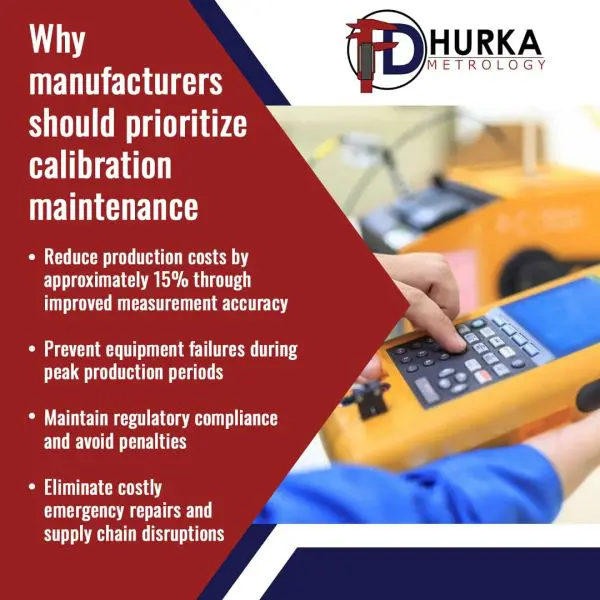
Production downtime represents the most immediate cost of calibration neglect. When measurement instruments fail accuracy requirements during critical production runs, entire batches may require rework or disposal. These incidents create supply chain disruptions that affect multiple customers simultaneously.
Quality Control Failures Drive Hidden Manufacturing Costs
ISO 17025-accredited calibration provides traceable measurement standards that courts and customers recognize during disputes. Without proper documentation, manufacturers cannot prove their measurements meet contractual requirements. This uncertainty creates liability exposure that insurance policies may not cover.
Customer Complaint Escalation Patterns
Customer complaints about product quality often trace back to measurement instrument problems. When calipers, micrometers, or coordinate measuring machines drift from specification, dimensional tolerances become unreliable. Products may pass initial inspection but fail at customer facilities where properly calibrated instruments reveal the true dimensions.
Warranty Cost Multiplication Effects
Warranty claims multiply when calibration programs fail to maintain measurement accuracy. Customers return products that don’t meet their quality standards, creating costly replacement cycles and damaged business relationships. These problems compound over time as measurement uncertainty affects multiple product lines.
Regulatory Compliance Creates Additional Financial Risk
Manufacturing companies in regulated industries face severe penalties for inadequate calibration programs. The Food and Drug Administration requires medical device manufacturers to maintain calibrated measurement systems throughout production processes. Similarly, aerospace contractors must demonstrate measurement traceability to maintain their certifications.
On-site calibration services become necessary when equipment cannot be moved from production areas. F.D. Hurka Metrology provides mobile calibration capabilities that minimize production interruptions while maintaining compliance requirements. Our technicians bring laboratory-grade standards directly to customer facilities.
Documentation requirements for regulated industries demand detailed calibration records with uncertainty calculations. Companies without proper calibration programs face audit findings that can shut down production lines. These compliance failures create legal exposure that exceeds the cost of regular calibration by enormous margins.
Production Efficiency Suffers from Measurement Uncertainty
Calibration services prevent the subtle efficiency losses that occur when measurement instruments gradually drift from accuracy. Operators compensate for perceived measurement problems by adding safety margins to manufacturing processes. These adjustments reduce throughput and increase material consumption without improving actual quality.
Operator Compensation Behaviors
Setup times increase when operators lack confidence in measurement instruments. Workers spend additional time verifying dimensions and checking results when they suspect calibration problems. This extra effort reduces productivity and increases labor costs across the entire manufacturing operations.
Process Optimization Barriers
Scrap rates climb when measurement uncertainty prevents operators from making proper process adjustments. Without accurate dimensional feedback, production teams cannot optimize cutting parameters, forming pressures, or assembly procedures. Materials get wasted while processes remain suboptimal due to measurement problems.
The National Institute of Standards and Technology analyses have estimated that meeting key measurement and technology infrastructure needs could lower production costs by around 15% in specific advanced manufacturing sectors (for example, roll-to-roll and certain flexible electronics processes). These sectoral savings illustrate how measurement capability gaps can have large economic impacts when left unaddressed.
Supply Chain Disruptions Multiply Calibration Neglect Costs
On-site calibration prevents supply chain interruptions that occur when critical measurement equipment requires off-site service. When companies delay calibration maintenance, instruments often fail during peak production periods. Emergency repairs cost considerably more than scheduled maintenance programs.
Supplier Relationship Damage
Supplier relationships suffer when measurement problems affect incoming inspection processes. Parts that meet supplier specifications may fail customer inspection due to calibration differences between facilities. These discrepancies create disputes that damage long-term business partnerships and increase procurement costs.
Just-in-time manufacturing systems cannot tolerate measurement delays caused by calibration emergencies. When critical instruments fail during production runs, entire supply chains experience delays while companies scramble to find replacement measurement capabilities. These disruptions affect multiple customers and create lasting damage to business relationships.
Technology Integration Requires Precise Calibration Standards
Modern manufacturing systems integrate multiple measurement technologies that depend on calibration accuracy. Statistical process control systems make decisions based on measurement data from various instruments. When calibration programs fail to maintain consistency between instruments, process control algorithms produce unreliable results.
Accredited calibration services provide the measurement traceability required for advanced manufacturing technologies. Industry 4.0 systems depend on accurate sensor data to optimize production parameters automatically. Calibration uncertainty corrupts this data and prevents intelligent manufacturing systems from performing effectively.
Predictive maintenance programs rely on accurate vibration, temperature, and dimensional measurements to forecast equipment failures. Poor calibration undermines these systems and leads to unexpected breakdowns that cost substantially more than prevented failures would have cost.
Building Effective Calibration Programs
ISO 17025-accredited calibration programs require systematic approaches that balance cost and risk across manufacturing operations. Companies must identify critical measurement points where accuracy directly affects product quality or safety. These instruments require more frequent calibration than general-purpose measuring tools.
Risk-Based Interval Planning
Calibration intervals should reflect actual usage patterns and environmental conditions rather than arbitrary schedules. F.D. Hurka Metrology works with customers to establish risk-based calibration frequencies that optimize both cost and measurement reliability. Our experience helps companies avoid both over-calibration and dangerous under-calibration.
Documentation System Requirements
Documentation systems must capture calibration results and track instrument performance over time. Electronic records should include:
- Calibration certificates with uncertainty measurements
- Historical performance trends for each instrument
- Due date tracking and automated reminders
- Audit trail documentation for regulatory compliance
- Performance analysis reports for interval optimization
This data helps companies optimize calibration intervals and identify instruments that may need replacement or more frequent attention.
F.D. Hurka Metrology: Your Partner in Measurement Excellence
F.D. Hurka Metrology has served North Carolina manufacturers since 1972, providing accredited calibration services that prevent costly quality problems. Our laboratory is ISO/IEC 17025-accredited (A2LA scope) and provides NIST-traceable calibration services for dimensional, electrical, and temperature measurements. When equipment cannot be moved, on-site (mobile) calibration services allow technicians to bring laboratory-grade standards to the production floor, minimizing downtime.
We understand the unique challenges facing modern manufacturers and design calibration programs that support both quality and profitability goals. Our team combines technical expertise with practical manufacturing experience to deliver solutions that work in real production environments.
Calibration services in North Carolina searches often lead companies to F.D. Hurka Metrology because we provide both on-site and in-house calibration services throughout the Southeast. Our mobile capabilities minimize production disruptions while maintaining the accuracy standards that modern manufacturing demands.
Charles Meredith leads our team with over 20 years of experience in precision measurement and calibration services. Under his direction, F.D. Hurka Metrology has built relationships with hundreds of manufacturers who depend on our expertise to maintain their competitive advantages.
Our commitment to customer service includes rapid turnaround times, competitive pricing, and flexible scheduling that accommodates production demands. We work as partners with our customers to develop calibration strategies that support their business objectives while meeting all regulatory requirements.
Frequently Asked Questions
Manufacturers often have similar concerns about calibration programs and their impact on operations. Here are answers to the most common questions we receive about calibration services and measurement maintenance strategies.
Q: How often should manufacturing instruments be calibrated?
A: Calibration frequency depends on usage, environmental conditions, and criticality to product quality. Calibration frequency should be risk-based: many companies schedule annual calibrations for critical instruments, while high-use or high-precision tools may require quarterly or monthly checks depending on usage, environment, and performance history. Risk assessment helps determine appropriate intervals for each instrument type.
Q: What happens if calibration reveals an instrument is out of specification?
A: Out-of-specification instruments require immediate removal from service until repairs restore accuracy. Companies must evaluate products manufactured since the last successful calibration to determine if quality problems occurred. This evaluation may require additional testing or customer notifications, depending on the severity of the calibration failure.
Q: Can companies perform their own calibration instead of using external services?
A: Internal calibration requires substantial investment in reference standards, training, and quality systems. Most companies find external accredited calibration more cost-effective because it eliminates the overhead of maintaining calibration capabilities. However, some high-volume manufacturers develop internal programs for routine instruments while using external services for critical or complex equipment.
Q: How does calibration documentation support quality audits?
A: Calibration certificates provide traceable evidence that measurement systems meet accuracy requirements. Auditors review calibration records to verify that companies maintain measurement control throughout their quality systems. Proper documentation demonstrates commitment to quality and helps prevent audit findings that could affect certifications or customer approvals.
Calibration Services in North Carolina for Better Performance
Regular calibration programs prevent expensive quality failures and protect manufacturing profitability. The hidden costs of skipping calibration far exceed the investment in preventive maintenance programs. Smart manufacturers partner with F.D. Hurka Company to maintain measurement accuracy and avoid the costly disruptions that calibration neglect creates. Contact us today to develop a calibration strategy that protects your quality standards and bottom line.

Chuck Meredith is a military veteran with over two decades of experience at FD Hurka Metrology. Since joining the company in 1999, Chuck dedicated 20 years to sales before stepping into the role of President in January 2020. Passionate about people and service, Chuck takes pride in ensuring FD Hurka provides exceptional gaging and calibration solutions to its customers.
GET IN TOUCH
Shipping Address
Mailing Address
Phone Number
Fax Number
CONTACT
To request specific information or to have someone from the F. D. Hurka Metrology contact you, please fill out the contact form or click the button below to request a quote:
