

In manufacturing, precision isn’t a nice-to-have: it’s what keeps production moving, customers satisfied, and audits stress-free. Yet many manufacturers across the Southeast still run into the same issue: measurements that may look correct on paper, but can’t be consistently verified, defended, and documented. When measurement confidence slips, so does everything built on it. A single calibration error can cascade into out-of-tolerance parts, rework, delayed shipments, product recalls, regulatory setbacks, and lasting damage to customer trust. That’s where metrological traceability becomes non-negotiable.
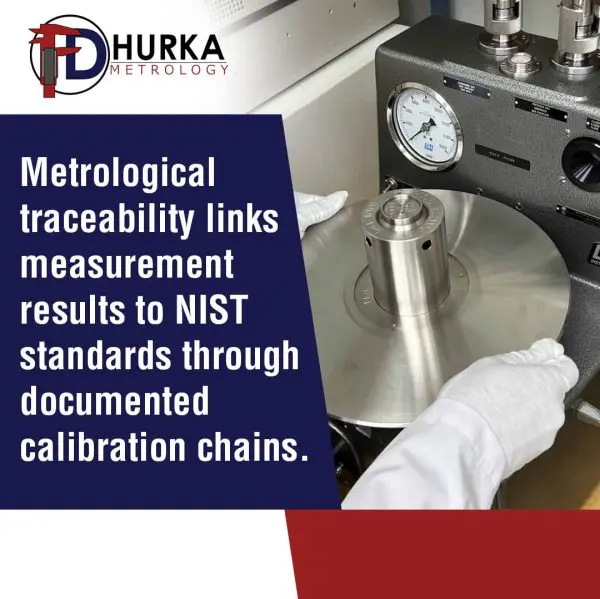
Traceability is the documented chain of evidence that proves a measurement result is linked, through an unbroken sequence of calibrations, to recognized national standards. It doesn’t just show that an instrument was checked; it shows how it was verified, against what, and with what uncertainty, so your quality system holds up under scrutiny.
For decades, F. D. Hurka Metrology has helped organizations maintain that level of measurement confidence. Through our ISO/IEC 17025–accredited calibration laboratory, we support automotive, aerospace, and manufacturing operations across nine southeastern states. From routine instrument calibrations to tighter tolerance requirements and audit-ready documentation, our team knows that true traceability is what separates dependable quality control from guesswork and keeps your measurements defensible at every stage.
What Is Metrological Traceability?
Metrological traceability is the documented link between a measurement result and recognized reference standards through an unbroken chain of calibrations. Each link in this chain includes stated measurement uncertainties.
The National Institute of Standards and Technology (NIST) defines metrological traceability as the “property of a measurement result whereby the result can be related to a reference through a documented unbroken chain of calibrations, each contributing to the measurement uncertainty.”
This definition carries three requirements:
- An unbroken chain of comparisons back to stated references
- Documented uncertainty values at each calibration step
- Clear records showing the complete measurement path
Why Does Calibration Traceability Matter for Quality Control?
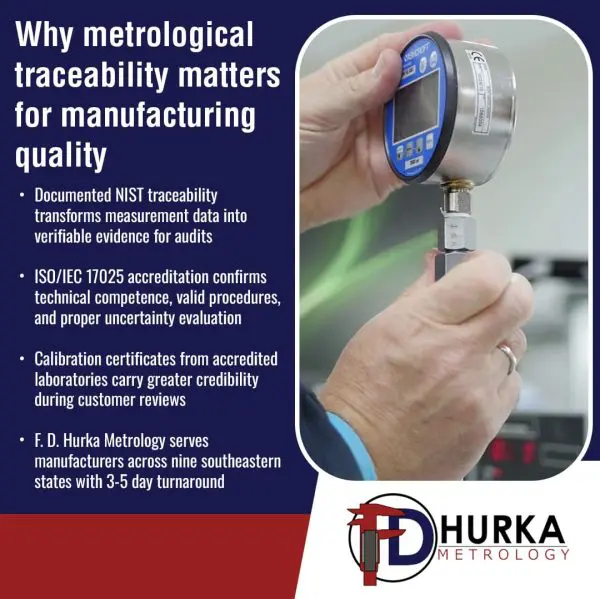
Calibration traceability transforms measurement data into verifiable evidence that auditors, customers, and regulatory bodies can trust. Without traceability in metrology, measurement results remain isolated numbers without validation.
Consider dimensional inspection of aerospace components. FAA regulations require documented proof that inspection equipment produces accurate results. Calibration and traceability together provide this proof. F. D. Hurka Metrology delivers ISO 17025-accredited calibration services that establish this documented connection.
Regulatory Compliance Requirements
Industries subject to FDA, FAA, or ISO standards require traceable measurements. A calibration certificate stating “NIST traceable” only has value when supported by:
- Complete documentation of the calibration chain
- Stated uncertainty values at each measurement step
- Evidence of competent laboratory practices
Customer Confidence and Market Access
Customers increasingly require suppliers to demonstrate metrological calibration practices. International trade agreements recognize traceable calibrations, opening market opportunities for compliant manufacturers.
How NIST Traceable Standards Support Traceability
NIST traceable standards serve as the foundation for measurement reliability in the United States. These standards provide the reference points that anchor calibration chains.
NIST operates as the National Metrology Institute (NMI) for the United States. The institute maintains primary standards for measurement units and provides calibration services that establish traceability to the International System of Units (SI).
The International Atomic Energy Agency (IAEA) states that metrological traceability is established through an unbroken chain of calibrations or comparisons that links measurement standards and results back to recognized reference standards, ultimately to realizations of the SI units.
F. D. Hurka Metrology maintains reference standards calibrated through laboratories with demonstrated traceability to NIST. Our metrological calibration services in Charlotte, NC, transfer this traceability to your measurement equipment.
The Calibration Chain Explained
Traceability in metrology functions through a hierarchical structure. Each level connects to the one above it through documented calibrations.
Level One: National Standards
NIST maintains primary realizations of SI units. These standards undergo international comparisons through the International Bureau of Weights and Measures (BIPM).
Level Two: Reference Laboratory Standards
Accredited calibration laboratories maintain working standards calibrated against NIST standards. F. D. Hurka Metrology holds A2LA accreditation to ISO/IEC 17025, demonstrating our competence to provide traceable calibration services.
Level Three: Working Standards
Manufacturing facilities maintain working standards calibrated by accredited laboratories. These standards provide a daily measurement reference.
Level Four: Production Instruments
Shop floor gages and inspection equipment receive calibration against working standards. This final link completes calibration traceability to the SI units maintained by NIST.
What Makes Calibration Traceability Valid?
Not all calibration certificates establish valid traceability in metrology. NIST identifies specific elements that support legitimate traceability claims:
- Complete measurement documentation describes the property measured, the measurement system used, and the conditions during calibration.
- Stated uncertainty values accompany each measurement result. Uncertainty evaluation follows established methods such as those in the Guide to the Expression of Uncertainty in Measurement (GUM).
- Reference standard identification specifies which standards were used and their traceability status at calibration time.
- Measurement assurance programs demonstrate ongoing control of calibration processes.
F. D. Hurka Metrology provides calibration certificates that include these elements. Our documentation supports your traceability claims during audits and customer reviews.
The Role of ISO 17025 Accreditation
ISO/IEC 17025 accreditation evaluates laboratory competence to perform calibrations. Accredited laboratories demonstrate:
- Technical competence of personnel
- Appropriate equipment and environmental controls
- Valid measurement procedures
- Proper uncertainty evaluation methods
- Effective quality management systems
Accreditation provides third-party verification that a laboratory can deliver traceable results. Metrological calibration performed by accredited laboratories carries greater credibility with auditors and customers. F. D. Hurka Metrology maintains ISO/IEC 17025 accreditation through A2LA, covering our calibration services for dimensional, mechanical, and electrical parameters.
How Measurement Uncertainty Affects Traceability
Measurement uncertainty quantifies the doubt surrounding any measurement result. Every calibration in the traceability chain adds uncertainty. The final measurement uncertainty combines all contributions from each link.
This relationship carries practical consequences for manufacturing operations:
Uncertainty Grows Through the Chain
Each calibration transfer adds measurement variation to the total uncertainty. Working with an ISO 17025-accredited calibration laboratory helps minimize these additions. Accredited laboratories maintain controlled processes and documented uncertainty budgets at each step.
Non-accredited providers may lack proper uncertainty documentation. This creates gaps in your traceability chain and can result in unknown or unnecessarily large measurement uncertainties. These gaps limit the tolerances you can reliably measure on the shop floor.
Uncertainty Determines Fitness for Purpose
Calibration traceability alone does not guarantee your measurements meet production requirements. You must compare total measurement uncertainty against part tolerances.
A commonly cited guideline in measurement practice is that the measurement uncertainty should be less than about 10% of the tolerance being evaluated, often referred to as the “golden rule.”
Calibration Certificates Must State Uncertainty
Valid metrological traceability requires documented uncertainty at each calibration step. Certificates lacking uncertainty statements do not support traceability claims. F. D. Hurka Metrology includes measurement uncertainty on all calibration certificates issued from our accredited laboratory.
When selecting calibration services, verify that providers include uncertainty values on their certificates. This information feeds into your own uncertainty budgets and supports audit documentation.
Common Misconceptions About Metrological Traceability
1. A NIST Certificate Number Proves Traceability
NIST test report numbers serve administrative purposes only. They do not by themselves establish traceability. Valid traceability requires documented chains of calibration with stated uncertainties.
2. Purchasing Calibrated Equipment Establishes Traceability
Owning calibrated instruments does not automatically make measurement results traceable. Your organization must maintain measurement assurance programs that verify instrument performance between calibrations.
3. Traceability Guarantees Fitness for Purpose
Metrological traceability does not guarantee that measurements meet specific application requirements. Traceability in metrology establishes the connection to reference standards. Your organization must verify that measurement uncertainties meet your particular needs.
Implementing Calibration and Traceability Programs
Effective programs require systematic approaches:
- Select appropriate reference standards based on required measurement uncertainties. Higher accuracy requirements demand more direct traceability paths. Your NIST traceable standards should match the precision level your applications demand.
- Establish calibration intervals that maintain measurement confidence. Factors include equipment stability, usage frequency, and accuracy requirements.
- Document all calibration activities, including environmental conditions, personnel involved, and reference standards used. Complete documentation supports valid calibration traceability claims.
- Monitor measurement processes between calibrations using check standards and control charts.
F. D. Hurka Metrology guides on implementing effective metrological calibration programs. Our 50 years of experience help clients establish systems that meet their specific requirements.
Questions About Traceability in Metrology
How often should calibrated instruments be recalibrated?
Calibration intervals depend on equipment stability, usage patterns, and accuracy requirements. Most quality systems require annual recalibration, but critical applications may need more frequent verification.
What is the difference between NIST traceable and ISO 17025-accredited calibration?
NIST traceable indicates a connection to NIST reference standards. ISO 17025 accreditation confirms laboratory competence. The strongest assurance combines both: accredited calibration with documented NIST traceability.
Can we claim NIST traceable standards if our calibration laboratory is not in the United States?
Yes, if the laboratory demonstrates metrological traceability through an unbroken calibration chain. The CIPM Mutual Recognition Arrangement allows recognition of calibration certificates from participating National Metrology Institutes worldwide.
Partner with F. D. Hurka Metrology
Calibration traceability protects your quality systems and supports regulatory compliance. F. D. Hurka Metrology provides ISO 17025-accredited calibration services with documented NIST-traceable standards.
Our Charlotte, North Carolina, facility serves clients throughout the Southeast. We offer a 3-5 day standard turnaround with competitive pricing. From metrological traceability documentation to complete calibration and traceability programs, we support your measurement quality goals. Contact us today to discuss your metrological calibration needs.
Trust your precision measurements to the calibration and traceability professionals who have served the region since 1970. We deliver the documentation and service quality your operations require.

Chuck Meredith is a military veteran with over two decades of experience at FD Hurka Metrology. Since joining the company in 1999, Chuck dedicated 20 years to sales before stepping into the role of President in January 2020. Passionate about people and service, Chuck takes pride in ensuring FD Hurka provides exceptional gaging and calibration solutions to its customers.
GET IN TOUCH
Shipping Address
Mailing Address
Phone Number
Fax Number
CONTACT
To request specific information or to have someone from the F. D. Hurka Metrology contact you, please fill out the contact form or click the button below to request a quote:
