

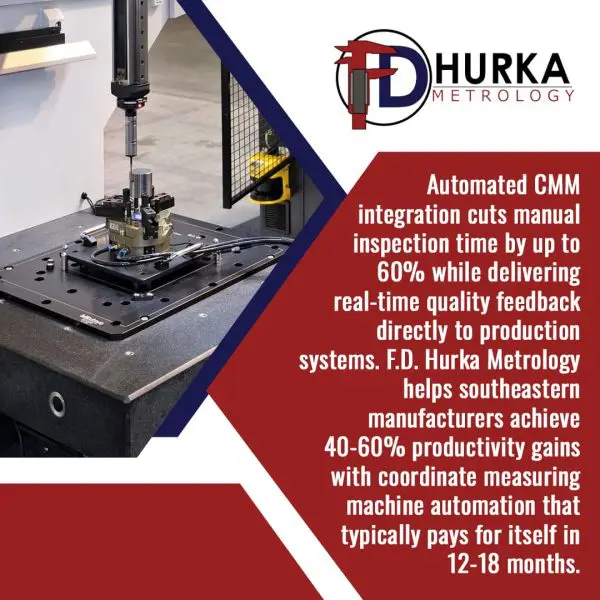
Coordinate measuring machine (CMM) integration with shop-floor automation creates automated quality control systems that reduce manual inspection time by up to 60% while maintaining measurement accuracy. Modern manufacturing facilities require seamless connectivity between CMM products and existing production lines to achieve real-time quality feedback and automated decision-making processes.
Shop-floor automation demands precise measurement data delivered instantly to production control systems. At F. D. Hurka Metrology in Charlotte, NC, we have witnessed manufacturers transform their quality processes through strategic CMM integration projects. Our experience shows that successful automation requires careful planning of communication protocols, data flow management, and operator training programs. The investment in automated CMM systems pays dividends through reduced scrap rates, faster throughput times, and improved product consistency across all manufacturing operations.
Understanding CMM Integration Requirements
Coordinate measuring machine (CMM) integration is the process of using standardized communication protocols to link CMMs to enterprise resource planning (ERP) platforms, supervisory control systems (SCADA), and factory execution systems (MES). The procedure calls for setting up automated decision-making logic, real-time reporting capabilities, and data sharing formats.
Prominent manufacturers of modern coordinate measuring machines incorporate built-in communication features, including web-based reporting interfaces, Ethernet TCP/IP, and OPC-UA protocols, into their devices. These features enable direct contact with production control systems without needing third-party interface solutions or custom programming.
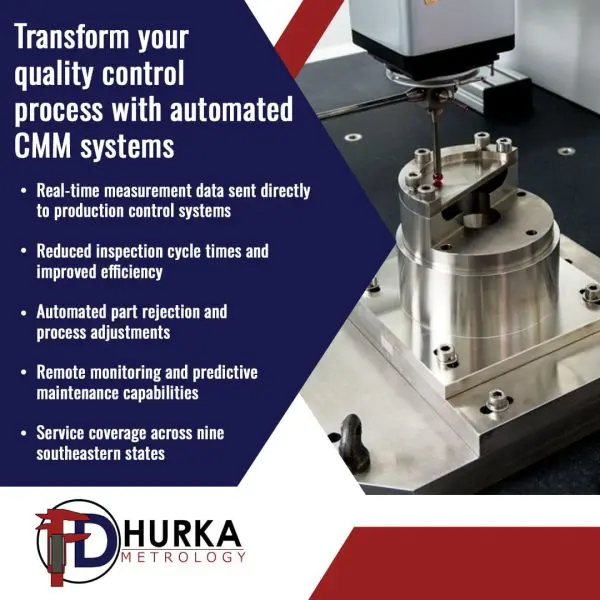
Data integration encompasses measurement results, part status information, calibration records, and quality trending reports. Manufacturing systems receive this information in real-time, enabling immediate responses to quality variations. Automated systems can trigger part rejection, process adjustments, or operator notifications based on predefined quality parameters.
We recommend evaluating your current system architecture before selecting CMM integration approaches. Network infrastructure, data storage capacity, and software compatibility determine your facility’s most effective integration methods.
Communication Protocols and Data Standards
Modbus TCP, Ethernet/IP, and OPC-UA are industrial communication protocols that facilitate smooth CMM data interchange with shop-floor automation systems. Thanks to these defined protocols, manufacturing control systems can receive diagnostic data, status updates, and measurement results from coordinate measuring devices.
Because of its standardized data modeling capabilities, cross-platform interoperability, and security features, OPC-UA (Open Platform Communications Unified Architecture) is the recommended protocol for CMM integration. This protocol supports real-time data transfer while system security and integrity standards are upheld.
Manufacturing facilities benefit from standardized data formats that allow different CMM products to communicate using identical protocols. Coordinate measuring machine manufacturers increasingly adopt these standards, reducing integration complexity and supporting multi-vendor environments.
Common Integration Scenarios
- Automated part loading systems that position components for CMM measurement
- Real-time statistical process control (SPC) data collection and analysis
- Automated pass/fail sorting based on measurement results
F. D. Hurka Metrology has implemented successful CMM integration projects across automotive, aerospace, and medical device manufacturing sectors. Each application requires specific protocol configurations to match existing automation infrastructure and quality requirements.
CMM Selection for Automated Environments
CMM selection for shop-floor automation requires evaluating measurement speed, accuracy, environmental tolerance, and integration capabilities alongside traditional specifications. Production environments demand coordinate measuring machines that operate reliably despite temperature variations, vibration, and contamination levels typical in manufacturing facilities.
Shop-floor CMM products must withstand temperature fluctuations of ±5°C while maintaining measurement accuracy within specified tolerances. The National Institute of Standards and Technology (NIST) emphasizes that highly stable thermal environments are essential for minimizing measurement uncertainty, especially during long step gauge measurements.
Bridge-style CMMs offer superior structural stability for automated applications compared to cantilever designs. These coordinate measuring machines provide consistent accuracy over extended measurement volumes while supporting automated part handling systems.
Mitutoyo CMMs, available through F. D. Hurka Metrology, incorporate advanced temperature compensation, vibration isolation, and environmental protection features specifically designed for production floor installations. These systems maintain measurement accuracy in challenging conditions while providing the connectivity options required for automation integration.
Five Critical Evaluation Factors
When evaluating shop-floor CMMs, consider these essential factors:
- Future-Proof Technology – Systems must support emerging communication standards and software upgrades without requiring hardware replacement. Modern coordinate measuring machine manufacturers provide firmware updates and protocol expansion capabilities.
- Productivity Maximization – Automated CMM systems should reduce cycle times while maintaining measurement quality. Multi-sensor capabilities and optimized measurement routines increase throughput rates.
- Connected Factory Integration – CMM products must communicate with Industry 4.0 platforms, cloud-based analytics systems, and mobile monitoring applications. Wireless connectivity and web-based interfaces support remote monitoring capabilities.
- Application-Specific Capabilities – Coordinate measuring machines must match your specific measurement requirements, including part size ranges, accuracy tolerances, and material types. Different applications require specialized probe systems and measurement strategies.
- Manufacturing Process Integration – CMM systems should integrate seamlessly with existing production workflows, part handling equipment, and quality management processes. Easy integration reduces implementation time and minimizes disruption to current operations.
Programming and Workflow Automation
Automated CMM programming reduces setup times from hours to minutes through feature recognition software, template-based routines, and CAD-driven measurement programs. Modern programming systems analyze part geometry and automatically generate measurement strategies optimized for speed and accuracy.
Offline programming capabilities allow measurement program development while coordinate measuring machines continue production measurements. This approach maximizes CMM utilization rates and reduces programming bottlenecks in high-volume manufacturing environments.
F. D. Hurka Metrology provides programming support and training services to help manufacturers implement automated CMM workflows. Our technical team works with clients to develop measurement strategies that balance throughput requirements with quality objectives.
Template-based programming systems allow operators to create measurement routines with minimal programming expertise for part families. These tools democratize CMM programming while maintaining measurement consistency across operators and shifts.
Data Management and Reporting Systems
Because automated CMM systems produce more than 1,000 measurement data points each hour, they need a strong data management system and the ability to handle data in real time. Continuous data streams must be handled by manufacturing databases that offer immediate access for decisions about process control.
Integration of statistical process control (SPC) enables capability studies, process variation analysis, and real-time monitoring of measurement trends. Automated SPC systems save 15–25% on quality-related expenses compared to manual data collecting techniques.
Cloud-based data management technologies offer advanced analytical features and scalable storage options. These systems provide historical trend analysis, remote monitoring, and predictive maintenance scheduling across several manufacturing sites.
Automation of report generation cuts reporting cycle times from days to minutes and does away with manual data compilation. Production managers, quality engineers, and operators can access real-time quality metrics through customizable dashboards.
We help customers deploy data management solutions with business software platforms and current quality management systems. Instead of only gathering measurement data, our method concentrates on producing information that can be put to use.
Integration Challenges and Solutions
Network security concerns require implementing segregated networks, encrypted communications, and access control protocols when connecting CMM systems to enterprise networks. Manufacturing cybersecurity frameworks must address both operational technology (OT) and information technology (IT) security requirements.
Legacy system compatibility challenges arise when integrating modern CMM products with older automation equipment. Protocol converters, gateway devices, and middleware solutions connect different technology generations.
Operator training requirements increase with automated systems due to additional troubleshooting responsibilities and system monitoring tasks. F. D. Hurka Metrology provides comprehensive training programs covering measurement principles and automation system operation.
Environmental considerations include power quality, network reliability, and physical space requirements for automated CMM installations. Coordinate measuring machine manufacturers specify installation requirements that must be met for warranty coverage and optimal performance.
Return on Investment Analysis
Automated CMM integration typically achieves payback periods between 12-18 months through labor savings, reduced scrap costs, and improved throughput rates. Manufacturing facilities report average productivity improvements of 40-60% after implementing automated measurement systems.
Labor cost reductions result from eliminating manual part handling, reducing inspection cycle times, and minimizing operator-dependent measurement variations. Automated systems operate continuously during production hours without breaks or shift changes.
Quality cost savings include reduced scrap rates, decreased rework requirements, and improved customer satisfaction metrics. Real-time quality feedback prevents defective parts from progressing through subsequent manufacturing operations.
We provide ROI analysis services to help manufacturers evaluate automation investment opportunities. Our assessments include total cost of ownership calculations, productivity projections, and quality improvement estimates based on your specific application requirements.
Service Areas and Support
F. D. Hurka Company provides CMM integration services and technical support across the southeastern United States. Our service territory includes:
- Alabama
- Florida
- Georgia
- Louisiana
- Mississippi
- North Carolina
- South Carolina
- Tennessee
- Virginia
Our technical team provides on-site installation support, programming assistance, and operator training services throughout these regions. Remote diagnostic capabilities and phone support ensure rapid response to technical issues and system optimization needs.
Preventive maintenance programs maintain automated CMM systems at peak performance levels while preventing unscheduled downtime. Regular calibration services and software updates keep coordinate measuring machines operating within specification requirements.
Moving Forward with CMM Automation
Successful CMM integration projects begin with detailed planning sessions that evaluate current processes, identify automation opportunities, and establish realistic implementation timelines. F. D. Hurka Metrology works with manufacturing teams to develop automation roadmaps that align with production goals and budget constraints.
Phased implementation approaches reduce risk and allow gradual operator adaptation to automated systems. Starting with single-cell automation and expanding to plant-wide integration provides learning opportunities and demonstrates ROI before major investments.
Your Next Steps in CMM Integration
Contact us to discuss your CMM integration requirements and explore automation opportunities for your manufacturing processes. We offer consultation, system design, and implementation support to help you improve quality and productivity through CMM automation in NC and nearby regions.

Chuck Meredith is a military veteran with over two decades of experience at FD Hurka Metrology. Since joining the company in 1999, Chuck dedicated 20 years to sales before stepping into the role of President in January 2020. Passionate about people and service, Chuck takes pride in ensuring FD Hurka provides exceptional gaging and calibration solutions to its customers.
GET IN TOUCH
Shipping Address
Mailing Address
Phone Number
Fax Number
CONTACT
To request specific information or to have someone from the F. D. Hurka Metrology contact you, please fill out the contact form or click the button below to request a quote:
