

Manufacturing operations across North Carolina often face a quality risk that’s easy to overlook: aging gage instruments. Tools that once produced dependable readings can slowly drift over time, quietly introducing measurement errors that lead to out-of-tolerance parts, rework, and costly production setbacks. For decades, F. D. Hurka Metrology has partnered with aerospace, automotive, and industrial manufacturers to solve this exact problem before it shows up on the floor or in an audit.
Upgrading gaging equipment isn’t as simple as swapping out a worn tool. The right decision depends on what the numbers say: measurement uncertainty, calibration history, performance trends, and current compliance expectations. F. D. Hurka Metrology helps manufacturers determine when a repair can restore confidence and extend useful life, and when replacement is the smarter long-term investment. Backed by ISO/IEC 17025–accredited calibration services, our team provides clear, data-driven documentation that supports defensible decisions and more consistent quality control.
What Is Gage Calibration?
Gage calibration is the process of comparing an instrument’s readings to those of reference standards that have documented traceability to national or international measurement standards, such as those maintained by the National Institute of Standards and Technology (NIST). As part of calibration, measurement uncertainty is quantified and reported.
During gage calibration, technicians measure artifacts with certified values. They record any deviations between instrument readings and known values. These deviations become documented corrections applied to future measurements.
At F. D. Hurka Metrology, we perform gage calibration on micrometers, calipers, height gages, and coordinate measuring machines. Each calibration generates a certificate documenting measurement results and associated uncertainties.
Signs Your Gage Instruments Need Replacement
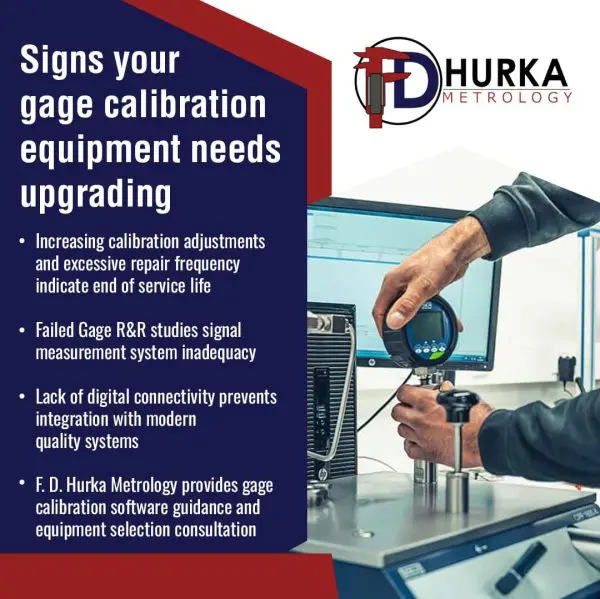
Increasing “As-Found” Error or Adjustment Trends
If the same gage keeps coming back from calibration with larger corrections (or a growing “as-found” error), it’s a strong signal that the instrument may be drifting or wearing. NIST guidance notes that calibration programs shouldn’t just file certificates; they should trend historical calibration data (often using tools like control charts) to demonstrate stability over time and support decisions about calibration intervals and instrument health.
Failed Gage R&R Studies
A Gage R&R (repeatability and reproducibility) study checks whether the measurement system variation is small enough to trust the data. Common Gage R&R criteria from AIAG state that when the total measurement system variation (Total Gage R&R) is less than 10% of the process variation, the system is acceptable. Between 10% and 30% may be acceptable depending on application and cost factors, while over 30% is usually unacceptable and signals a need for improvement.
Limited Data Capture or Record Integration
Older gages may not support straightforward digital output or easy electronic recordkeeping. Manual data entry of calibration results can introduce transcription errors. Integrated digital output and automated recordkeeping help reduce these risks, and many quality management standards recommend electronic traceability and audit trails to support data integrity.
Frequent Breakdowns or Disruptive Repairs
If a gage is repeatedly out of service or requires constant attention, the hidden cost is downtime and process disruption. According to the International Society of Automation, manufacturing plants can lose approximately 5%–20% of annual productivity to unplanned downtime, highlighting the importance of gage reliability and preventive calibration programs.
Selecting the Right Gage Calibration Partner
The right calibration partner combines technical accreditation, fast turnaround, and documented traceability. Look for ISO/IEC 17025 accreditation from a recognized body like A2LA. This standard verifies laboratory competence through independent assessment. Evaluate turnaround times against your production schedule.
F. D. Hurka Metrology maintains a 3-5 day turnaround for in-house calibration. Review calibration certificates for complete measurement uncertainty statements and clear traceability paths. Ask about on-site calibration options for equipment that cannot be shipped. A strong calibration partner understands your industry requirements and communicates proactively about due dates and equipment issues.
How Gage Calibration Software Improves Equipment Management
Gage calibration software automates calibration scheduling, tracks equipment history, and generates compliance documentation. These systems eliminate manual tracking errors and provide audit-ready records.
Key capabilities of modern gage calibration software include:
- Automated calibration due-date notifications
- Historical trend analysis for each instrument
- Certificate generation with electronic signatures
- Integration with enterprise quality systems
- Mobile access for technicians in the field
Many facilities find that gage calibration software delivers significant time savings and improved traceability as the number of instruments grows. In practice, organizations routinely adopt such systems once instrument counts and calibration complexity grow beyond basic spreadsheet tracking.
Comparing Gage Management Software Options
A gage management software system organizes all calibration-related data in a centralized database. This differs from basic spreadsheet tracking by providing validation controls and audit trails. Selecting the right gage management software depends on your facility size and compliance requirements.
| Feature | Spreadsheet Tracking | Gage Management Software |
| Automated reminders | Manual setup required | Built-in scheduling |
| Audit trails | Limited or none | Complete history |
| Compliance reports | Custom creation needed | Pre-configured templates |
| Multi-user access | File sharing issues | Role-based permissions |
| Equipment location tracking | Manual updates | Real-time visibility |
| Integration capability | Limited | API connections |
F. D. Hurka Metrology assists manufacturers in selecting gage management software that matches their operational requirements. We provide calibration data in formats compatible with major software platforms.
Building an Effective Gage Calibration System
A gage calibration system encompasses equipment, procedures, personnel, and documentation working together. Each component affects overall measurement quality. The right gage calibration system adapts to your specific industry requirements.
Equipment Selection
Choose gage calibration equipment matched to your measurement requirements. A common industry rule of thumb for measurement systems is that the standard uncertainty of a calibration standard should be substantially smaller than the process tolerance, often recommended at a 4:1 ratio. This guideline helps ensure that measurement uncertainty does not significantly affect decision limits, though specific industry requirements vary.
Calibration Intervals
NIST guidance indicates that calibration intervals should reflect actual equipment stability and usage conditions. New gage calibration equipment may require shorter intervals until stability is established. Well-maintained gage instruments with a stable history may support extended intervals.
F. D. Hurka Metrology evaluates each customer’s usage patterns to recommend appropriate calibration frequencies. We adjust intervals based on documented performance data.
Environmental Controls
Temperature variations affect dimensional measurements. Steel expands and contracts with temperature. For typical steel alloys used in gaging equipment, the coefficient of thermal expansion is approximately 11.7 × 10⁻⁶ per °C — meaning a 1 °C change can change a 1-meter reference length by roughly 11.7 micrometers. Measurement environments must be controlled or compensations applied.
Why NIST Traceability Matters for Gage Calibration Equipment
Metrological traceability, as defined by NIST, applies to measurement results and requires an unbroken documented chain of calibrations from the measurement result back to SI units or other specified reference standards, with stated measurement uncertainties. This chain connects your shop-floor measurements to internationally recognized SI units.
When you send gage calibration equipment to F. D. Hurka Metrology, we calibrate against reference standards traceable to NIST. Our ISO/IEC 17025 accreditation demonstrates technical competence verified by independent assessors.
Customers in regulated industries – aerospace, automotive, medical device manufacturing – require documented traceability. Auditors examine calibration certificates for clear statements of measurement uncertainty and traceability paths.
Example Scenario For Automotive Supplier Upgrades Measurement Capability
Consider an automotive parts supplier facing a common challenge. Their aging micrometers show acceptable calibration results individually. However, gage R&R studies reveal measurement variation exceeding 30% of part tolerance. This situation triggers audit concerns and potential customer complaints.
A thorough inspection of their gage instruments might uncover worn spindles, causing inconsistent contact pressure. The supplier’s gage calibration management software tracks calibration dates but lacks trend analysis features needed to identify gradual degradation.
Recommended solutions in this scenario would include:
- Replacing worn micrometers with digital models featuring data output
- Upgrading to gage calibration management software with statistical trending
- Reducing calibration intervals from 12 months to 6 months until stability is established
- Training operators on proper measurement technique
This type of systematic approach typically yields measurable improvements. Gage R&R results can improve to under 15% of tolerance within a few months. The investment in new gage instruments and software often pays for itself through reduced scrap and rework.
Questions We Hear from Manufacturers
1. How often should gage calibration equipment be recalibrated?
Initial intervals of 6 to 12 months are common, with adjustments based on documented stability. Heavy-use equipment may require quarterly calibration. Light-use reference standards may support 24-month intervals after demonstrating stability.
2. What is the difference between gage calibration software and gage management software?
Gage calibration software focuses on the calibration process itself: data collection, certificate generation, and procedure management. Gage calibration management software provides broader asset management, including location tracking, cost analysis, and vendor management. Many modern systems combine both gage calibration software and management functions.
3. Can worn gage instruments be repaired instead of replaced?
Repair makes sense when component wear is localized, and replacement parts are available. F. D. Hurka Metrology evaluates repair versus replacement costs for each situation. When repair costs exceed 50% of replacement value, new equipment typically provides better long-term value.
4. What documentation should accompany upgraded gage calibration equipment?
New gage instruments should include manufacturer calibration certificates, operating instructions, and specifications. Before placing equipment in service, perform an incoming inspection against your measurement requirements. Document this verification in your gage calibration system.
Take the Next Step with F. D. Hurka Metrology
Equipment upgrades represent investment decisions that affect measurement quality for years. F. D. Hurka Metrology provides the technical expertise to evaluate your current gage instruments and recommend appropriate solutions.
Our services include:
- In-house calibration with 3-5 day turnaround
- On-site calibration throughout nine southeastern states
- ISO/IEC 17025 accredited calibration to A2LA standards
- Contract inspection lab using CMM, vision systems, and hand tools
- Equipment support and training programs
For gage calibration in North Carolina, South Carolina, Alabama, Florida, Georgia, Louisiana, Mississippi, Tennessee, & Virginia, contact us. Let us help you build a measurement system that supports your quality objectives.

Chuck Meredith is a military veteran with over two decades of experience at FD Hurka Metrology. Since joining the company in 1999, Chuck dedicated 20 years to sales before stepping into the role of President in January 2020. Passionate about people and service, Chuck takes pride in ensuring FD Hurka provides exceptional gaging and calibration solutions to its customers.
GET IN TOUCH
Shipping Address
Mailing Address
Phone Number
Fax Number
CONTACT
To request specific information or to have someone from the F. D. Hurka Metrology contact you, please fill out the contact form or click the button below to request a quote:
