

Temperature is one of the most overlooked variables in precision measurement. For manufacturers across aerospace, automotive, medical devices, and other precision-driven industries, a few degrees of variation can push a perfectly good part out of tolerance. At F. D. Hurka Metrology, we have seen firsthand how uncontrolled thermal conditions lead to rejected parts, rework costs, and compliance failures. The impact of temperature effects on measurement is not theoretical. It is a daily operational risk.
Manufacturers who rely on high-precision measuring tools cannot afford to treat temperature as an afterthought. From calipers to coordinate measuring machines (CMMs), every instrument responds to heat. Knowing how to manage thermal conditions is just as important as calibration frequency. This article explains what happens to your tools under thermal stress and how to reduce measurement error in your facility.
What Is the Standard Reference Temperature for Measurement?
The internationally accepted reference temperature for dimensional measurement is 20°C (68°F). This standard, defined in ISO 1 (Geometrical Product Specifications), sets the baseline at which all length measurements are considered valid.
Most calibration laboratories, including ISO/IEC 17025 accredited facilities, conduct calibrations at or near this temperature. When your shop floor or measurement room operates far outside this range, thermal expansion introduces errors that cannot be corrected after the fact.
According to NIST (National Institute of Standards and Technology), thermal expansion is often a dominant source of uncertainty in dimensional metrology. NIST guidelines specifically address how laboratories must account for temperature when establishing traceability to national standards.
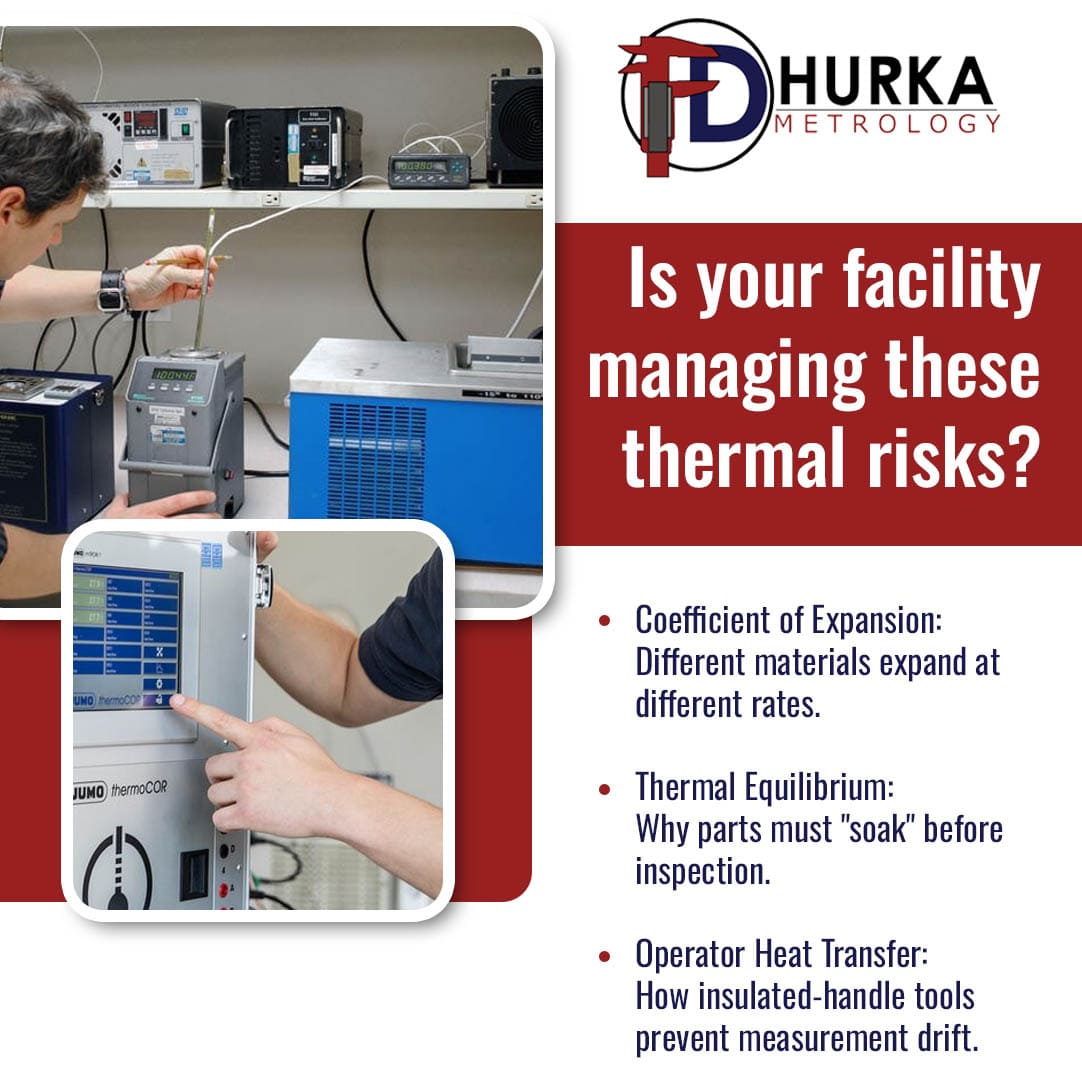
How Temperature Affects High-Precision Measurement Tools
All materials expand when heated and contract when cooled. The rate at which they change size is called the coefficient of thermal expansion (CTE). Different tool materials respond differently to the same temperature change.
| Material | CTE (μ m/m/°C) | Common Use |
| Steel (carbon) | 11.7 | Gage blocks, calipers |
| Aluminum | 23.1 | Aerospace parts, fixtures |
| Invar (Fe-Ni alloy) | 1.2 | Precision CMM components |
| Granite | 8.0 | Surface plates, CMM tables |
When a steel caliper and an aluminum part are at different temperatures, both are expanding or contracting at different rates. The reading you get may not reflect the true dimension of the part.
Calipers and Micrometers
Handheld high-precision measuring tools like calipers and micrometers are especially vulnerable to operator-induced thermal error. Simply holding the tool warms the metal. A technician with warm hands can transfer enough heat to shift a micrometer reading by several microns.
Best practice: Allow tools to acclimatize in the measurement environment for at least one hour before use. Use insulating grips or gloves when handling.
Coordinate Measuring Machines (CMMs)
CMMs are designed for high-accuracy dimensional inspection. However, they are also sensitive to thermal gradients. A temperature difference of just 1°C across a CMM structure can introduce positional errors in the range of microns to tens of microns, depending on the machine size.
Most CMM manufacturers specify a temperature stability requirement, typically ±1°C per hour or ±2°C over 24 hours, for accurate operation.
Gage Blocks
Gage blocks are calibrated at 20°C. Using them on a hot shop floor introduces direct error. A steel gage block measuring 100 mm, used at 25°C instead of 20°C, will measure approximately 0.006 mm longer than its certified value. In tight-tolerance manufacturing, this matters.
Temperature Effects on Measurement Across Key Industries
The impact of temperature effects on measurement varies by industry. Below are sectors where thermal control is non-negotiable.
Aerospace
Aerospace components require tolerances as tight as ±0.001 inches or less. Structural parts made from aluminum, titanium, or carbon composites all respond differently to heat. Measurements taken at inconsistent temperatures can result in parts that pass inspection but fail in service conditions.
Automotive
Engine components, transmission parts, and brake assemblies all demand dimensional accuracy. Automotive manufacturers often run multiple shifts in facilities that experience temperature swings from morning to afternoon. Without temperature-controlled inspection rooms, measurement results can vary between shifts.
Medical Devices
Implants, surgical instruments, and diagnostic equipment must meet strict dimensional standards. Regulatory bodies require documented measurement traceability. Temperature instability introduces uncertainty that may not be correctable during post-inspection review.
Electronics and Semiconductor
Printed circuit boards and semiconductor wafers involve features measured in nanometers. Even small thermal variations can cause fixture expansion that affects alignment and inspection results. Climate-controlled cleanrooms are standard in this industry for this reason.
What the Research Says About Thermal Measurement Error
NIST guidance on measurement uncertainty recognizes Type B components as those evaluated from scientific judgment, prior data, calibration reports, specifications, and known material behavior. In dimensional metrology, NIST also notes that thermal expansion and deviations from the 20°C reference temperature can contribute significantly to uncertainty budgets and should be considered when relevant to traceable measurements.
For manufacturers seeking ISO/IEC 17025-accredited dimensional calibration services, this means calibration providers should evaluate temperature-related effects when they influence measurement uncertainty. F. D. Hurka Metrology supports this requirement through ISO/IEC 17025:2017-accredited calibration services and temperature- and humidity-controlled laboratory environments.
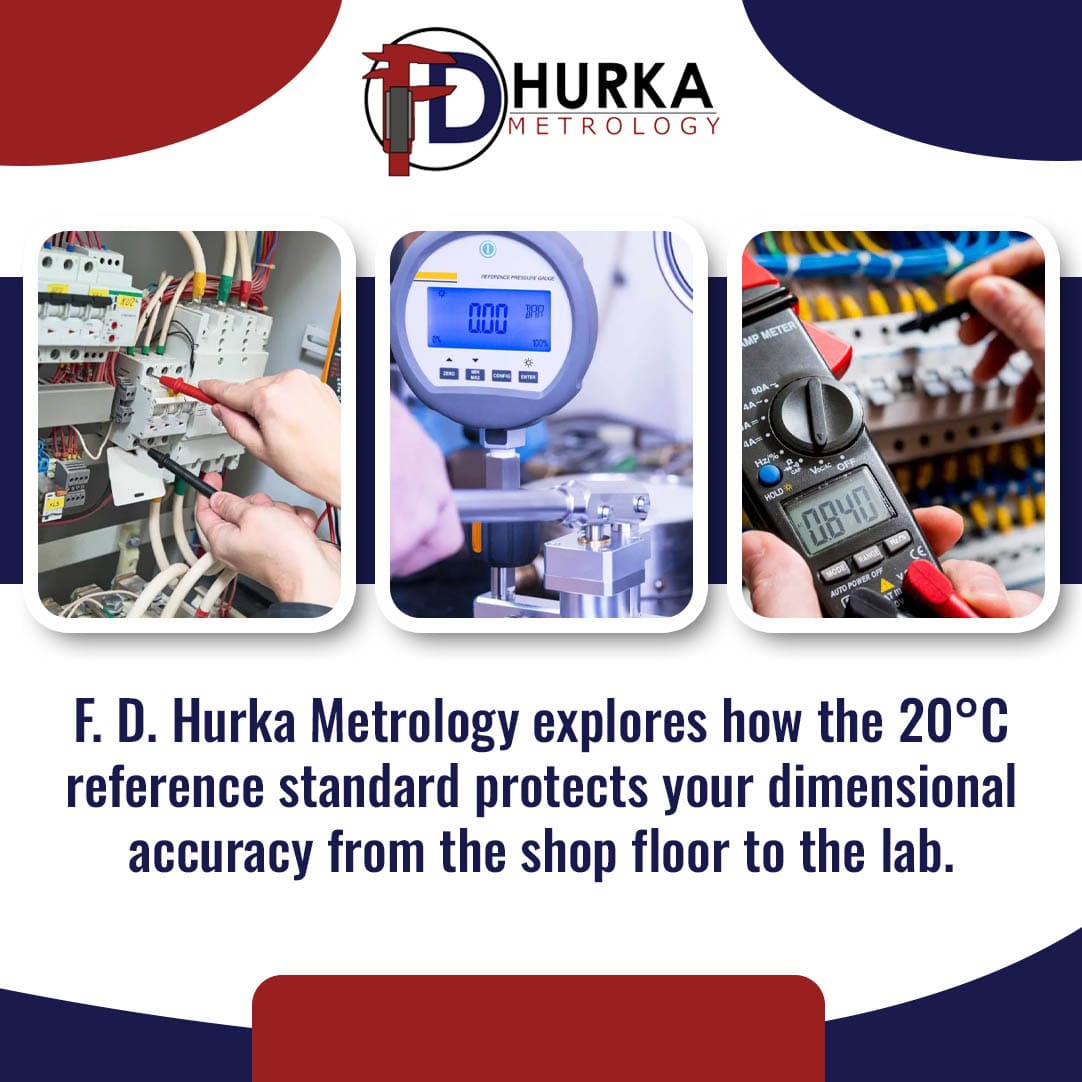
How to Control Temperature Effects in Your Measurement Process
Managing thermal error does not require a multimillion-dollar climate system. Several practical steps reduce measurement uncertainty on most production floors.
-
- Maintain a dedicated measurement room at or near 20°C. Separate this space from heat-generating machinery.
- Allow parts to soak in the measurement environment before inspection. Soak time depends on part mass, geometry, and material. A large aluminum casting pulled directly from a warm production cell can take several hours to reach thermal equilibrium with the room.
- Choose tools with insulated handles or thermal barriers to limit body heat transfer to the instrument. Holding a bare steel micrometer for just a few minutes can raise its temperature enough to shift readings by several microns.
- Record the ambient temperature at the time of each measurement and include it in your inspection records. This data supports traceability and helps identify patterns when measurement results drift over time.
- Apply thermal correction factors when measuring parts made from materials with different CTEs than your reference standard. Use published CTE values for each material and document your correction method.
- Schedule critical measurements during stable temperature periods, typically early morning, before production equipment warms up.
- Maintain a dedicated measurement room at or near 20°C. Separate this space from heat-generating machinery.
When your measurement process is supported by regularly calibrated precision measurement tools, thermal control becomes part of a complete quality system rather than an afterthought.
Calibration Services and Pricing at F. D. Hurka Metrology
At F. D. Hurka Metrology, we offer ISO/IEC 17025-accredited calibration services for a wide range of high-precision measurement tools. Our standard turnaround time is 3 to 5 business days, and our pricing is structured to be competitive without sacrificing accuracy or documentation quality.
Our calibration services cover instruments, including but not limited to:
- Calipers (digital, vernier, and dial)
- Micrometers (outside, inside, and depth)
- Gage blocks and ring gages
- Height gages and dial indicators
- Thread gages and plug gages
- CMM qualification and verification
We serve manufacturers across nine Southeastern states from our Charlotte, North Carolina, facility. On-site calibration services are also available for equipment that cannot be transported without affecting its calibration status.
Our customers consistently recognize the value we deliver. Eric Coates shared: “Amazing customer service. Always helpful and quick responses. Their prices are hard to beat too. One of the best calibration houses we have used. Highly recommend them.”
If you are looking to control temperature effects on measurement through properly calibrated instruments and documented uncertainty budgets, F. D. Hurka Metrology is ready to help.
Common Questions About Temperature and Precision Measurement
What is the best temperature for dimensional measurement?
The internationally accepted reference temperature for dimensional measurement is 20°C (68°F), as defined by ISO 1. Deviations from this temperature must be documented and, where possible, corrected.
How much error does a 5°C temperature change cause?
A 5°C change on a 100 mm steel part introduces approximately 0.006 mm of dimensional change. For tight-tolerance work, this is significant. The actual error depends on the part material and its coefficient of thermal expansion.
Do I need temperature-controlled calibration?
Yes, if your products require traceable calibration under ISO/IEC 17025. Accredited laboratories are required to account for temperature in their uncertainty budgets. Calibrations performed without thermal control may not meet your quality system requirements.
Can F. D. Hurka Metrology calibrate on-site?
Yes, F. D. Hurka Metrology offers on-site calibration services for instruments that cannot be removed from your facility. Our team brings calibrated reference standards and maintains traceability throughout the process.
How often should precision measurement tools be calibrated?
Calibration intervals depend on how frequently the tool is used, its criticality, and your quality system requirements. Most quality standards recommend recalibration at least annually, with more frequent intervals for heavily used or high-stakes instruments. F. D. Hurka Company can help you set appropriate intervals based on your measurement history.
Protecting Your Measurement Accuracy in Charlotte and Across the Southeast
Temperature is not a minor variable. It is a direct contributor to measurement error in manufacturing. Whether you use calipers, micrometers, or a full CMM suite, the temperature effects on measurement are real and quantifiable.
F. D. Hurka Metrology has supported precision manufacturers since 1970. Our ISO/IEC 17025 accredited calibration services help you build a measurement process that holds up under audit, reduces scrap, and supports your quality goals. We serve manufacturers across Charlotte, NC, and throughout the Southeast. Click on our contact page to learn more.

Chuck Meredith is a military veteran with over two decades of experience at FD Hurka Metrology. Since joining the company in 1999, Chuck dedicated 20 years to sales before stepping into the role of President in January 2020. Passionate about people and service, Chuck takes pride in ensuring FD Hurka provides exceptional gaging and calibration solutions to its customers.
GET IN TOUCH
Shipping Address
Mailing Address
Phone Number
Fax Number
CONTACT
To request specific information or to have someone from the F. D. Hurka Metrology contact you, please fill out the contact form or click the button below to request a quote:
